Reduce BECE subjects from 10 to four to ease stress, save time -GES told
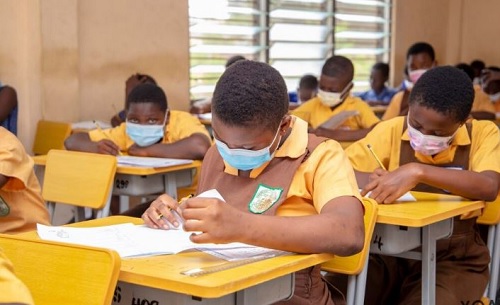
Kofi Asare, executive director of Africa Education Watch, has suggested reducing the number of papers written during the Basic Education Certificate Examination (BECE) from the current 10 or 11 subjects to just four.
According to him, this would shorten the examination period from five or six days to only two, cutting costs and easing the stress associated with an exam that now mainly serves as a placement tool for senior high schools.
Mr Asare proposed that students be examined in four areas: Mathematics, English, General Science and a General Paper. The General Paper, he explained, would combine sections from subjects such as Computing, Ghanaian Language, Social Studies and others to ensure students still study the full curriculum. Optional language subjects would remain separate.
At present, BECE candidates sit papers in English Language, Religious and Moral Education, Social Studies, Creative Arts and Design, Science and Career Technology, Mathematics, Ghanaian Language, French, Computing and Arabic for students in Islamic schools.
Explaining his proposal in an interview with the Daily Graphic, Mr Asare said the introduction of Free SHS in 2017 had significantly changed the role of the BECE. Previously, the examination largely determined whether students qualified for secondary education, with fewer than 65 per cent meeting the admission benchmark of Aggregate 35.
Today, however, about 98 per cent of BECE candidates gain admission into secondary school, with even students scoring Aggregate 54 securing placement. As a result, he argued, the exam now functions mainly as a system for assigning students to schools rather than deciding who progresses to secondary education.
Mr Asare questioned why students still spend five days writing 10 subjects for what is essentially a placement exercise. He noted that in many countries, placement decisions rely more on aptitude tests and continuous assessment than broad, high-stakes examinations.
He maintained that if the BECE is to remain relevant, its structure should reflect its current purpose. Under his proposal, Mathematics, English and Science would remain standalone subjects, while all other subjects would be combined into a General Paper. He believes this would reduce the burden on students, improve efficiency and potentially lower examination costs by as much as 40 per cent. He added that Ghana currently spends more than GH¢200 million annually on the BECE.
Addressing concerns that reducing the number of subjects could weaken educational quality, Mr Asare argued that there is no clear evidence supporting that claim. He compared such concerns to arguments that increasing admissions into law and medical schools automatically lowers standards.
He called for evidence-based discussions on whether maintaining 10 separate BECE subjects truly improves learning outcomes, insisting that reducing the exam to four papers while still covering the entire curriculum would not necessarily compromise quality.