“Advocacy Groups Asleep” as Ghana Loses $2.5B Yearly to Galamsey, Rivers Poisoned
Story : Maurice Otoo
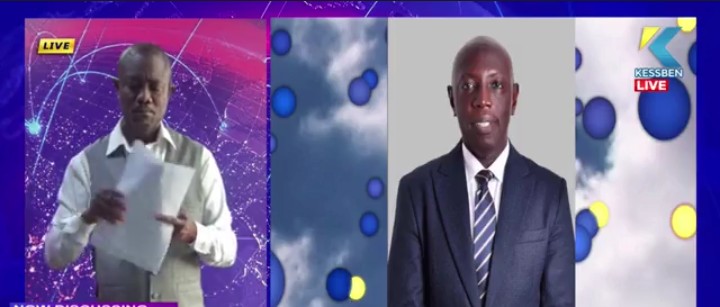
Prof.Isaac Boadi, Dean of the Faculty of Accounting and Finance at UPSA/ IERPP, has decried what he calls a worrying silence around Ghana’s deepening galamsey crisis, warning that natural resource losses are crippling the economy.
Speaking on developments via zoom interview on Kessben TV’s Digest, Prof. Boadi said, “We at Institute of Economic Research and Public Procurement ( IERPP) were discussing what is happening in Ghana that looks like nobody’s business.” He noted that all the advocacy groups that stood forth previously seem to be asleep or unconcerned now.
According to IERPP’s assessment, the scale of destruction is staggering. IERPP gave the scale of destruction regarding our natural resources which amount to $2.5 billion annually through galamsey and $2.3 billion in annual revenue loss of timber,
Prof. Boadi revealed.
He stressed that our water bodies are contaminated, citing the Eastern, Western, Ashanti, Savannah East, Central, Northern, and Upper East regions. Rivers including Pra, Ankobra, Offin, Birim, Tano, Densu and Black Volta are all confirmed poisoned, he said.
Between 2025 and 2026, Ghana recorded 15 major documented illegal exploitation of natural resources, he stated.
He acknowledged that the previous government. did its bid but could not solve it.
Prof. Boadi also referenced a government admission that it has noticed its own people and some traditional rulers embedded in galamsey but we could not question who were involved.
He is now calling for renewed civic pressure saying, we are asking for the awakening of all advocacy groups to arise and speak to the pending issues, he said. The loss is as a result of irresponsible mining and smuggled gold revenue.
Questioning current interventions, he added: _“If the government has indeed initiated measures to mitigate the situation, how has the outcome been?”
“No government intends to kill its citizens but if your governance is not going well, we must arise and speak against it,”_ Prof. Boadi concluded.
The Ministry of Lands and Natural Resources and the Environmental Protection Agency are yet to respond to the IERPP figures and the call for advocacy groups to re-engage.