Ghana’s Quiet Diplomat Turns a UN Victory into Global Leverage … How Ablakwa Is Redefining National Power
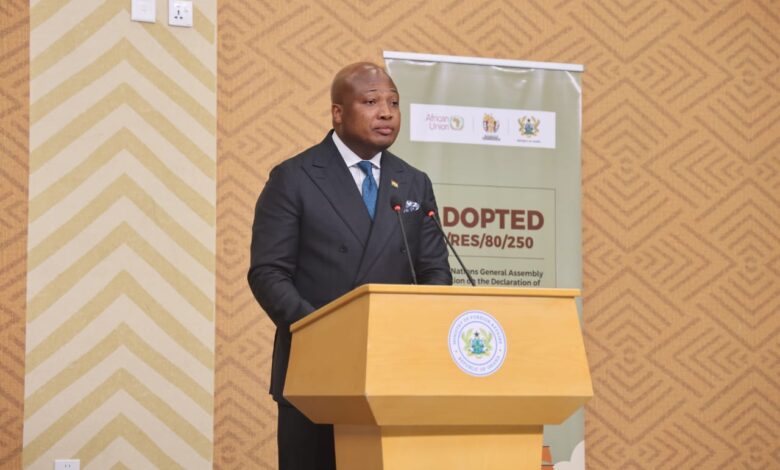
When the 123 delegates at the United Nations General Assembly voted to adopt Ghana’s Resolution (A/80/L.48) to designate the Transatlantic trafficking of Enslaved Africans and the entire racialized chattel enslavement as “the gravest crime against humanity,” the moment was widely framed as President John Dramani Mahama’s moral leadership. That was true — but it was incomplete.
The real architect of the vote’s operational success was Foreign Affairs Minister, Samuel Okudzeto Ablakwa, whose unassuming steadiness stitched together the political, technical, and human threads that turned a bold idea into a global consensus. The immediate triumph at the UN is more than a symbolic win; it is a strategic opening for Ghana. What follows is a clear blueprint for how that diplomatic capital can be converted into sustainable influence, economic advantage, and durable leadership on the international stage.
Mr. Ablakwa’s rise into the corridors of global diplomacy reflects a disciplined climb: early responsibility in information, and education portfolios, years of parliamentary mastery, and a ministry that has prioritized substance over spectacle. That experience paid off when a politically sensitive Resolution, — laden with historical grievances and legal complexities — had to be recast as a forward-looking, practical framework acceptable to a broad plurality of states.
His skill was not merely rhetorical. He engineered a coalition: careful bilateral outreach, targeted briefings that neutralized objections, and a narrative that reframed reparations as restorative justice rather than retroactive punishment. The result was not just a majority vote; it was the reframing of Ghana as a principled leader with the capacity to translate moral clarity into multilateral outcomes.
Why this matters for Ghana’s future is simple: in international affairs, reputation is a form of currency. A country that demonstrates competence, steadiness and moral clarity reduces perceived political risk. Investors, development partners, and other states pay attention not only to GDP figures and policy reform agendas but to the credibility of governance.
Mr. Ablakwa’s stewardship has enhanced Ghana’s brand as a reliable, values-driven actor — and that improved brand can lower the political risk premium investors attach to projects in Ghana, expand access to concessional finance, and create openings for high-profile foreign direct investment.
But reputation alone isn’t enough. Turning the UN win into tangible gains requires deliberate follow-through. The Ministry of Foreign Affairs (MFA) must now institutionalize the victory. That starts with creating permanent structures — a “Global Issues & Coalitions” cell within the MFA that tracks emerging multilateral debates, builds cross-regional alliances, and keeps the policy conversation moving from resolutions to implementation. It means investing in research units that produce evidence-based policy papers and negotiating toolkits so Ghana can lead on substance, not just symbolism.
Critically, Ghana must translate moral leadership into policy leadership. This involves sponsoring follow-up initiatives that operationalize the UN motion: implementation frameworks, pilot programmes, and practical modalities for reparative financing and restorative projects. By spearheading technical guidelines and pilot projects, Ghana can move the conversation beyond rhetoric, attracting multilateral institutions and donor bodies willing to fund concrete programs. When moral arguments are linked to development outcomes — community restoration, scholarships, heritage preservation, climate-resilient infrastructure — they become easier to finance and easier to sustain.
Economic diplomacy must be central to the follow-up. The MFA should align closely with trade and investment agencies to convert goodwill into deals. That means coordinated trade missions to capitals that supported the motion, investor round-tables targeted at impact and ESG funds, and sector-focused roadshows in areas where Ghana already has competitive advantage — agro-processing, sustainable cocoa value chains, renewable energy, and digital services. The narrative matters: frame Ghana as a stable partner committed to justice and to a predictable regulatory environment. That message will appeal to investors looking for jurisdictions with both ethical standing and institutional capacity.
A significant opportunity lies with environmental, Social and Governance (ESG) and impact investors. The global rise of responsible capital means funds are actively seeking investments that combine financial returns with measurable social impact. Ghana’s leadership on restorative justice resounds with such investors. The government can capitalize by creating impact-focused investment windows, public–private partnership funds, and guarantees that de-risk early-stage social and green infrastructure projects. These instruments will attract patient capital that values governance and social commitment — precisely the type of capital likely to be drawn to a country whose diplomacy signals alignment with ethical investing principles.
Regional leadership is another vector for leverage. By convening cross regional working groups and hosting international summits, Ghana can cement a role as convener and agenda-setter in Africa and beyond. Strengthened regional credibility enhances Ghana’s negotiating power in implementation of the African Continental Free Trade Area (AfCFTA) and in mobilizing support for transnational infrastructure projects — ports, power interconnectors, logistics hubs — that are essential to expanding trade capacity. Such projects multiply returns by lowering trade costs and integrating regional value chains, making Ghana more attractive as a manufacturing and logistics hub.
But diplomatic boldness carries risks. States that abstained or opposed the motion may harbour residual distrust. Ghana must therefore practice pragmatic diplomacy: engage quietly with skeptical partners, protect bilateral economic relationships, and use soft, steady outreach to avoid trade frictions. At home, expectations will rise; the government must manage them with a clear pipeline of initiatives that translate diplomatic capital into jobs and measurable outcomes. Without demonstrable follow-through, moral victories can ring hollow.
Practical governance changes will be required to sustain the momentum. The MFA needs secure funding lines for long-term coalition building and economic diplomacy. An inter-ministerial coordination mechanism should be established to operationalize international commitments domestically — aligning Foreign Affairs, Trade, Finance, Justice, and Culture around a shared agenda. Performance metrics for diplomats, linked to coalition successes, investment wins and negotiated frameworks, will professionalize incentives and anchor Ghana’s newfound credibility.
Public diplomacy is the final, indispensable pillar. The MFA must expand digital outreach, produce accessible policy briefs, host regular briefings with international media and thought leaders, and actively engage the diaspora and civil society as amplifiers. Institutional memory matters: a searchable diplomacy knowledge base should document contacts, promises, and outcomes so that progress isn’t lost between political cycles.
The Ablakwa moment demonstrates a truth about modern statecraft: power is increasingly exercised through persuasion, coalition-building, and the ability to convert normative wins into policy outcomes. Ghana’s UN success is a launchpad — not a destination. If the government moves swiftly to institutionalize the gains, link moral leadership to development projects, and enforce disciplined economic diplomacy, the country can convert a reputational surge into concrete trade and investment advantages. The Ghana Foreign Affairs Minister’s quiet, methodical approach shows what effective stewardship looks like: persistent work, strategic patience, and a capacity to make international principles serve national interests.
The question now is whether Ghana will treat this as a single bright moment or as the opening chapter of an enduring strategy. The choice is straightforward. By doubling down on institutions, aligning diplomatic wins with economic policy, and maintaining pragmatic relations with the broader international community, Ghana can ensure that this UN triumph becomes a lasting shift in its global standing — translating moral authority into tangible prosperity for its people. Samuel Okudzeto Ablakwa provided the steady hand that won the vote; it’s up to Ghana’s leaders to transform that hand into a tool for national renewal.