Mahama reflects on father’s detention, reaffirms lifelong dedication to justice and human rights
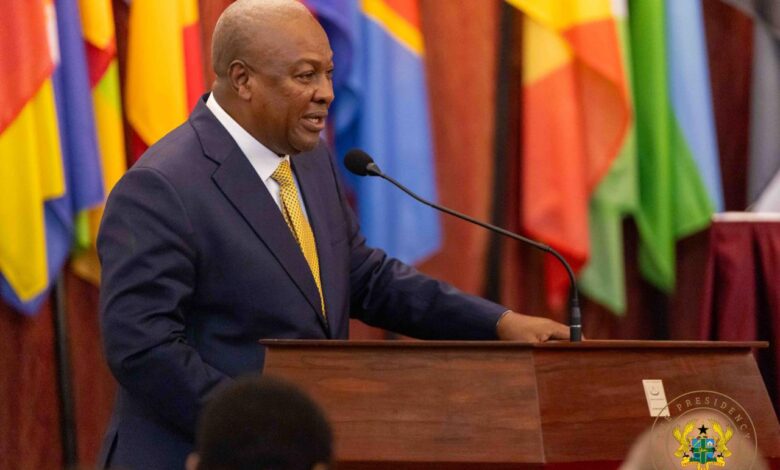
President John Dramani Mahama delivered a profoundly introspective and emotionally resonant keynote address during the opening ceremony of the 2026 Judicial Year and the 20th Anniversary celebrations of the African Court on Human and Peoples’ Rights in Arusha, Tanzania, where he recounted how the detention of his father in the aftermath of Ghana’s 1966 military coup indelibly shaped his philosophical commitment to justice, constitutionalism, and the sanctity of human dignity.
Addressing an august gathering of African Heads of State, eminent jurists, diplomatic envoys, and representatives of civil society, President Mahama situated his remarks within both personal history and continental political experience, arguing that Africa’s democratic trajectory must be fortified by resilient institutions capable of safeguarding civil liberties against arbitrary exercises of power.
“I remain the child whose father was detained for serving his country and advising its leader,” he remarked, invoking his family’s experience as a symbolic representation of the human consequences of political instability and constitutional ruptures that characterized many post-independence African states.
The President observed that early exposure to the ramifications of political upheaval profoundly influenced his appreciation of institutional accountability and the fragility of fundamental rights in environments where judicial safeguards are weakened. He emphasized that the denial of justice to any individual inevitably produces cascading social consequences that extend beyond the immediate victim.
“When injustice is visited upon one person, it does not terminate with that individual,” he stated solemnly. “Rather, it reverberates through families, communities, and sometimes across successive generations.”
Mahama underscored that his political and humanitarian convictions were largely forged by these formative experiences, which reinforced his steadfast advocacy for judicial independence, procedural fairness, and the protection of constitutionally guaranteed freedoms. He stressed that governance systems must be designed to guarantee the right to fair hearing and equitable treatment under the law.
“It is precisely because of such lived experiences that I hold such strong conviction in due process, in the inviolability of the right to be heard, and in the protection of fundamental human rights,” he affirmed. “No citizen should be compelled to endure injustice simply because the institutions entrusted with safeguarding them have failed in their duty.”
Turning his attention to the broader African political landscape, President Mahama argued that the continent’s historical encounters with coups d’état, unlawful detentions, and abrupt constitutional interruptions should serve as enduring reminders of the imperative to strengthen democratic governance structures. He warned that sustainable development on the continent remains intrinsically linked to the consolidation of rule-based governance and judicial autonomy.
“Our continent’s historical experience teaches us that justice cannot be relegated to chance or political convenience,” he said. “Justice must be deliberately constructed, carefully protected, and firmly anchored in institutions that are impartial, independent, and resilient to political interference.”
He further praised the African Court on Human and Peoples’ Rights as a vital continental institution dedicated to protecting fundamental freedoms and ensuring state accountability under the provisions of the Banjul Charter. According to him, the Court represents not only a legal mechanism but also a moral symbol of Africa’s collective determination to uphold human rights standards.
“For me, this is not an abstract legal discourse,” President Mahama concluded. “This is deeply personal. It is about ensuring that no child in Africa must grow up witnessing a parent suffer injustice without the possibility of legal redress.”