President Mahama unveils vision to democratise STEM education across Ghana
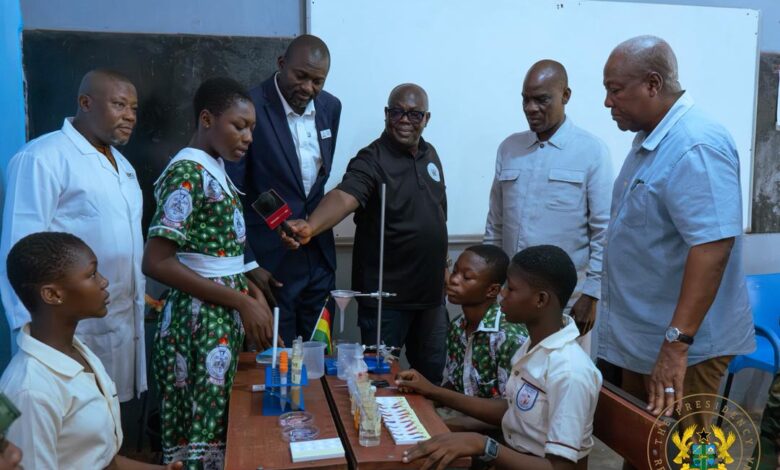
President John Dramani Mahama has unveiled plans to decentralise and democratise Science, Technology, Engineering and Mathematics (STEM) education across the country to ensure that every Ghanaian child has access to practical science learning.
Speaking during a demonstration of the national BSTEM programme at Sawla E/A Primary School in the Savannah Region as part of his “Resetting Ghana Tour,” President Mahama said the government’s vision is to move away from an education system where STEM opportunities are concentrated in a few specialised schools.
According to him, stand-alone STEM schools often benefit only a limited number of students, leaving many children without access to modern science and technology education.
“The problem with those stand-alone STEM schools is that it gives access only to a privileged few. Our idea is to democratise STEM and decentralise it so that every child can have the opportunity to learn science, technology, engineering, and mathematics,” he stated.
President Mahama noted that many children lose interest in science and mathematics because of the traditional methods used in teaching the subjects.
“We have realised that it is the way science and mathematics are taught that make a lot of our children not want to take the science and engineering routes,” he said.
He explained that practical learning methods used in STEM education help children understand concepts more easily by allowing them to interact directly with objects and teaching materials.
“In the past when we were in school, they would just come and take a chalk and draw a triangle on the blackboard and say this is a triangle. The child has to conceptualise in his mind what a triangle is, or what a pyramid is, or what an oval is, or what a rectangle is,” he recalled.
“Today they can see the physical object that we call a rectangle and they can hold it in their hands and see the size and shape of a rectangle,” he added.
The President described STEM education as a more practical and engaging approach to teaching science, technology, engineering and mathematics, saying it could encourage more young people to pursue careers in innovation and engineering.
“And so STEM is a more practical way of teaching them science, technology, engineering, and mathematics. We want to decentralise STEM so that every Ghanaian child has the opportunity to learn in an easier manner than we have taught it in the past,” he stressed.
In a light-hearted moment, President Mahama reflected on his own experiences with mathematics lessons during his school days, saying the rigid teaching methods at the time often frightened students.
“At that time, we used to do mental. They would come with a ship-9 times 9, 9 times 9, ship! 18 times 24, ship! I mean, you just scared the child,” he said, drawing laughter from the audience.