Mahama announces STEM school, TVET centre and new university for Savannah Region
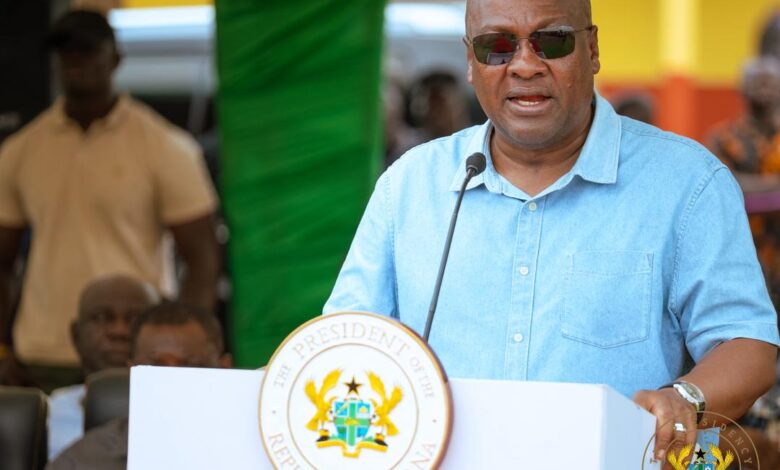
President John Dramani Mahama has announced a major education expansion agenda for the Savannah Region, including plans to establish a STEM secondary school, a Technical and Vocational Education and Training (TVET) centre, and a University of Science and Technology.
The President made the announcement during the sod-cutting ceremony for the Bole College of Education as part of his “Resetting Ghana Tour” of the Savannah Region.
According to President Mahama, the projects form part of a broader strategy to bridge the development gap between northern Ghana and the rest of the country through improved access to quality education and skills training.
He disclosed that a new Science, Technology, Engineering and Mathematics (STEM) secondary school will be constructed in Tinga to equip students with practical and technology-driven skills needed for the future economy.
In addition, the government plans to establish a TVET centre in Kulmasa to strengthen technical and vocational training opportunities for young people in the region.
President Mahama also announced plans for the creation of a University of Science and Technology for the Savannah Region, describing it as a transformative intervention that would expand tertiary education opportunities and accelerate socio-economic development.
“All these are projects meant to bring the northern regions up to catch up with the other parts of the country,” he said.
The President stressed that education remains one of the most effective tools for tackling poverty and promoting social mobility in underserved communities.
“We know that poverty is endemic in our area, and education is one of the means of social mobility,” he stated.
President Mahama explained that his administration is focused on decentralising access to quality education so that students in northern Ghana can pursue higher learning and technical training closer to home.
The announcement comes alongside ongoing efforts to expand educational infrastructure in the Savannah Region, including the construction of the Bole College of Education, which is expected to accommodate 1,500 students upon completion.
Residents and local leaders at the event welcomed the planned projects, expressing optimism that the new institutions would create opportunities for the youth and contribute to the region’s long-term development.