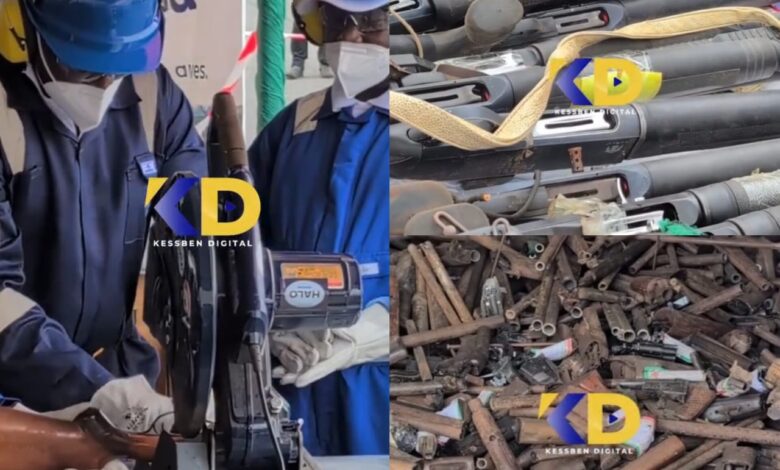
The Ministry of the Interior, in collaboration with the Ministry of Defence, the National Commission on Small Arms and Light Weapons, and Halo Trust, has destroyed more than 4,000 illegal firearms as part of Ghana’s 8th National Arms Destruction Ceremony.
The event, held to commemorate the United Nations Small Arms Destruction Day, brought together government officials, traditional leaders, clergy, security agencies, members of the diplomatic community, the media, and international security partners.
The exercise which was held at National Police Training School-Tesano , formed part of the government’s Gun Amnesty Programme, which was launched to retrieve unregistered firearms from across the country.
According to the Ministry, the recovered weapons included pistols, pump-action guns, AK-47 rifles, single-barrel and double-barrel guns, as well as other locally manufactured and imported firearms.
Addressing the ceremony, the Minister for the Interior, Mubarak Muntaka Mohammed, commended the Ghana Police Service and citizens who voluntarily surrendered their weapons during the amnesty period.
He stressed that reducing the number of illegal firearms in circulation is key to minimizing violent crime and improving public safety, adding that a gun-free society is essential for national peace and security.
Guest of Honour, Chief of Staff Julius Debrah, also praised the initiative, describing the retrieval and destruction of unregistered firearms as a critical step toward addressing threats to Ghana’s national security.
He issued a strong warning that the amnesty period has officially ended and that security agencies will now strictly enforce the law against anyone found in possession of unregistered firearms.
According to him, individuals who continue to keep illegal weapons will be arrested and prosecuted in accordance with the laws of Ghana.
The firearms destruction exercise underscores the government’s commitment to combating the proliferation of illegal weapons and strengthening national security through sustained enforcement and public cooperation.
By Maurice Otoo