Ghana Positioning Itself at Centre of Emerging Global Financial Market Architecture-BoG Governor
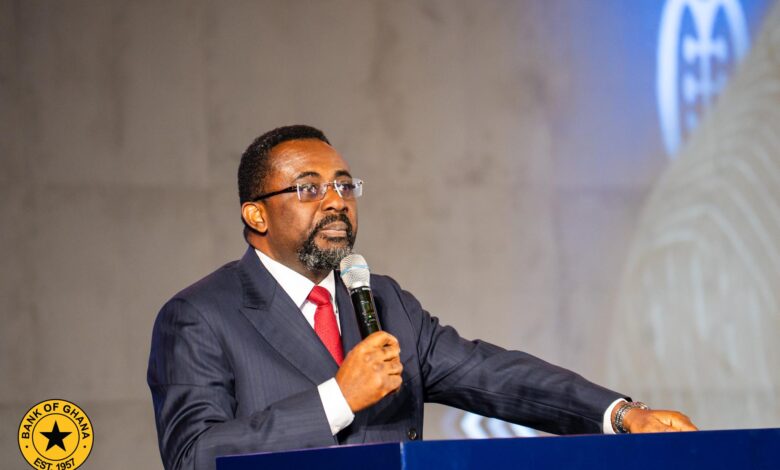
Governor of the Bank of Ghana, Dr. Johnson Pandit Asiama, has declared that Ghana is positioning itself as a key contributor to the next phase of global financial market transformation, driven by digital innovation, regulatory reforms, and regional financial integration.
Speaking at the opening of the ACI FMA World Congress 2026 in Accra on Thursday, Dr. Asiama said the global financial system was being reshaped in real time, with emerging economies increasingly playing a central role in designing the future of finance.
The Congress, held under the theme “Ghana at the Centre of a New Financial Markets Era,” brought together central bank governors, financial market leaders, regulators, and industry executives from across the world.
Dr. Asiama said Ghana’s recent macroeconomic recovery had laid the foundation for deeper financial market transformation, stressing that stability remained the “infrastructure” upon which innovation and market development depended.
He recalled that Ghana faced severe economic challenges three years ago, including inflation peaking at 54.1 percent in December 2022, declining reserves, debt restructuring pressures, and weakened market confidence.
According to him, decisive policy actions by the Bank of Ghana and the Ministry of Finance had since restored stability.
“The result, by April this year: inflation at 3.4 percent, reserves above US$13.9 billion, more than five months of import cover, 1,400 basis points off the policy rate since early 2025, fiscal consolidation holding, and a banking system recapitalised and lending again,” he stated.
Dr. Asiama said the progress was not a cause for complacency, noting that geopolitical tensions and global uncertainties continued to pose risks to economies worldwide.
He stressed, however, that Ghana’s experience demonstrated that macroeconomic stability was essential for building competitive and innovative financial systems.
The Governor outlined what he described as three major shifts redefining financial markets in emerging economies.
The first, he said, was the growing importance of digital payments infrastructure.
He noted that payment systems were no longer merely the “back office” of finance, but had become the gateway into formal financial systems for millions of people.
Dr. Asiama highlighted Ghana’s interoperable payment ecosystem, developed through the Ghana Interbank Payment and Settlement Systems (GhIPSS), including instant transfers, mobile money integration, QR-code interoperability, and digital settlement infrastructure.
He disclosed that Ghana’s central bank digital currency, the e-Cedi, had completed its pilot phase and was now being designed for cross-border settlement and wholesale payment applications.
“The strategic question is no longer whether to build digital sovereign infrastructure. The strategic question is what economic activity we choose to enable once we have it,” he said.
On regulation, Dr. Asiama argued that strong regulatory frameworks were necessary to sustain innovation in digital finance.
He said Ghana’s Virtual Asset Service Providers Act, passed in 2025, was being operationalised through detailed regulations to ensure market integrity and investor protection.
The Governor also pointed to the Bank of Ghana’s fintech sandbox, supervisory technology investments, and strengthened cybersecurity frameworks as part of efforts to build trust in the digital finance ecosystem.
“Innovation without regulatory architecture is fragile. Innovation embedded within credible regulatory architecture compounds,” he stated.
Dr. Asiama further underscored the importance of regional integration, saying African markets that remained disconnected would struggle to compete globally.
He revealed that Ghana was working with regional partners on fintech licence passporting initiatives, harmonised payment systems, and broader efforts to build a connected African financial market.
“A payment initiated in Accra should clear in Abidjan or Lagos as easily as it clears in Kumasi,” he said.
The Governor said emerging economies were increasingly moving from being passive recipients of financial market policies to active designers of policies suited to their own conditions.
“A growing number of emerging economies, Ghana among them, are no longer countries to which financial market policy happens. We are countries in which financial market policy is being designed,” he said.
Dr. Asiama urged participants at the Congress to focus on building financial systems capable not only of adapting to global change, but also shaping it.
“Ghana has chosen to be part of that redesign. Not as a participant. As a contributor,” he added.