Parliament urged to fast-track AU free movement protocol ratification as integration gaps exposed
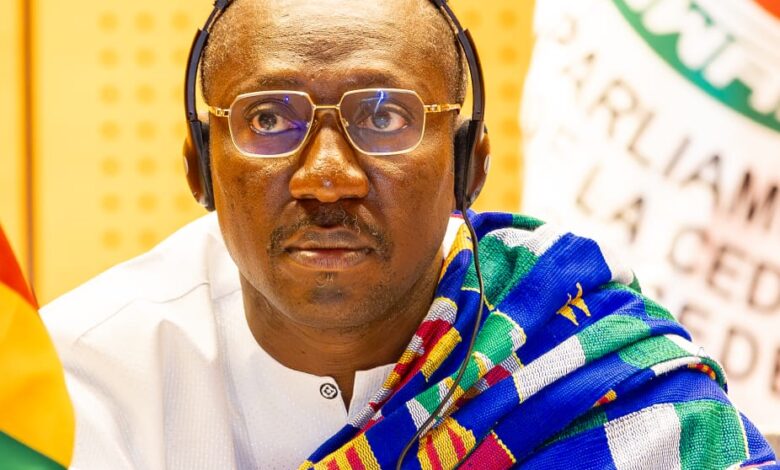
A powerful intervention on the floor of the ECOWAS Parliament has reignited debate over Africa’s stalled integration agenda, with a strong call on West African governments to urgently ratify the African Union’s Protocol on the Free Movement of Persons.
Delivering a statement of urgent public interest, the Third Deputy Speaker, Hon. Osahene Alex Afenyo Markin warned that without free movement, Africa’s flagship trade initiative, the African Continental Free Trade Area, risks failing to deliver its full promise for the continent’s 1.5 billion people.
At the heart of the address was a stark contradiction: while African leaders have moved swiftly to liberalise trade, they have failed to match that commitment with the political will to allow Africans themselves to move freely across the continent.
The AU Free Movement Protocol was adopted by all African Union member states in January 2018, just two months before those same countries signed onto the AfCFTA agreement later that year. Yet, eight years on, progress has been negligible.
Only four countries, namely, Rwanda, São Tomé and Príncipe, Niger, and Mali, have ratified the protocol, far below the minimum threshold of 15 required for it to enter into force.
ECOWAS Paradox
Critically, both Niger and Mali have exited ECOWAS, meaning that technically no ECOWAS member state has ratified the AU protocol, despite the bloc being widely regarded as Africa’s most advanced region on free movement.
The speech highlighted a paradox at the core of West Africa’s integration story. ECOWAS has long been seen as a leader in facilitating movement across borders, dating back to its 1979 protocol which allows visa-free travel within the region.
However, the Deputy Speaker argued that this progress remains incomplete and fragile. Citizens still face harassment, extortion, and illegal checkpoints across borders, undermining the very spirit of regional integration.
More fundamentally, the failure to ratify the AU’s continental protocol means ECOWAS is not legally aligned with Africa’s broader integration architecture.
The address made a clear and uncompromising point: AfCFTA cannot work without the free movement of people.
While 49 African countries have ratified AfCFTA, the continued restrictions on movement of persons create a structural contradiction. Goods are expected to move freely, but the traders, entrepreneurs, and workers behind them cannot.
“We cannot build a true African Continental Free Trade Area if people cannot move with their goods,” the Deputy Speaker stated.
This disconnect, he warned, risks turning AfCFTA into a partial and underperforming framework rather than the transformative single market envisioned.
Direct Call to ECOWAS States
In one of the most pointed sections of the speech, ECOWAS member states were urged to act decisively by completing their domestic ratification processes and depositing instruments with the African Union without delay.
A formal resolution is being proposed within the ECOWAS Parliament to:
* Name member states yet to ratify the protocol
* Demand accelerated legislative action
* Require regular reporting on progress until full ratification is achieved.
*Regional Leadership Under Scrutiny*
The speech also singled out Ghana, noting the contradiction between its leadership role, hosting the AfCFTA Secretariat and its failure to ratify the free movement protocol.
While Ghana ranks highly on visa openness and has championed integration discussions, it has yet to complete ratification, with a target set for 2027.
The Deputy Speaker warned that such delays must not become a comfort zone, stressing that leadership on integration must be matched by legal commitment.
Mr. Afenyo Markin’s intervention concluded with a broader warning: “Africa’s integration challenge is no longer about vision or policy design, but about implementation.”
With fewer than two years to key continental milestones under the Abuja Treaty framework, the failure to operationalise free movement risks undermining decades of ambition.
For ECOWAS, the message was clear, the region must move from being a symbolic leader of free movement to a legal and continental champion of it.
And, for Africa as a whole, the call was even sharper: without freeing its people, the continent cannot truly free its trade.
To donate or add your signature to the ten million and support the movement, visit: www.makeafricaborderlessnow.com
To download the APD 2026 Action Compact, visit: https://africaprosperitynetwork.com/wp-content/uploads/2026/02/APD-Compact-Feb-2026.pdf
To download the Make Africa Borderless Now! Movement Manifesto, visit: https://africaprosperitynetwork.com/wp-content/uploads/2026/02/4-MAKE-AFRICA-BORDERLESS-NOW-Manifesto-1.pdf