GES warns teachers against protesting at headquarters during school hours

The Ghana Education Service (GES) has cautioned teachers, particularly newly recruited staff, against leaving their duty posts to gather at the Service’s headquarters or engage the media during official school hours.
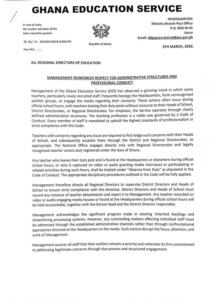
In a directive issued on March 9, 2026, and addressed to all Regional Directors of Education, GES management expressed concern about what it described as a growing trend of teachers forming unrecognised groups, besieging the headquarters, and airing grievances through the media instead of using the established administrative channels.
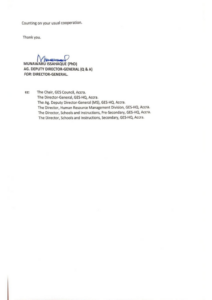
According to the directive signed by the Acting Deputy Director-General in charge of Quality and Access, Dr. Munawaru Issahaque, the actions of some teachers undermine the administrative structures of the Service and violate the professional code governing the teaching profession.
GES emphasised that teachers with concerns must first report them to their Heads of School before escalating them through the District and Regional Directorates where necessary. The national office, it explained, engages directly only with Regional Directorates and legally recognised teacher unions.
Management warned that any teacher found at the GES headquarters or participating in media engagements during official school hours would be considered absent from duty under the Service’s Code of Conduct and could face disciplinary action.
Regional Directors have therefore been tasked to ensure strict compliance with the directive by supervising District Directors and Heads of Schools to monitor and report any instances of teacher absenteeism.
The directive also indicated that teachers who engage the media or visit the headquarters during official hours could be held accountable alongside their School Heads and District Directors.
While acknowledging progress made in clearing inherited administrative backlogs and improving processing systems, GES urged staff with outstanding issues to follow the appropriate administrative procedures rather than adopting confrontational approaches.
Management further assured staff that their welfare remains a priority and reiterated its commitment to addressing legitimate concerns through due process and structured engagement.