Charlia Kweh Calls for Women-Led Climate Resilience at DPS International Model United Nations 2026
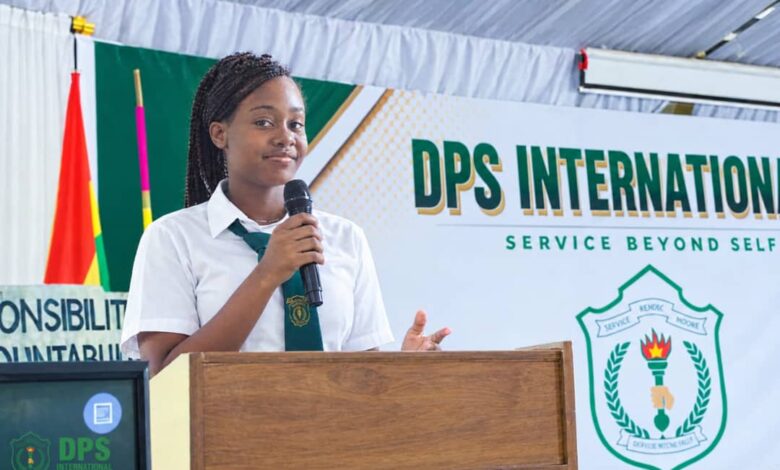
Charlia Kweh, a Liberian student studying at DPS International Ghana, has called for stronger gender-responsive strategies to help women lead recovery and resilience efforts in communities affected by climate change, conflict and displacement.
Speaking as the Delegate of Pakistan at the DPS International Model United Nations 2026 under the UN Women committee, Kweh argued that women should not be viewed merely as victims of climate and humanitarian crises, but as “architects of resilience.”
Addressing the agenda, “Women as Architects of Resilience: Enhancing Gender-responsive Strategies in Post-Conflict and Climate Stressed Zones,” Kweh highlighted Pakistan’s vulnerability to climate-related disasters despite the country contributing less than one percent of global greenhouse gas emissions.
“Pakistan comes to this committee not necessarily as a contributor to the global climate crisis, but as one of its most severe victims,” she said.
Kweh pointed to Pakistan’s devastating 2022 floods as an example of how climate disasters can disproportionately affect women and vulnerable communities.
According to the figures presented in her address, the floods affected about 33 million people, left one-third of the country underwater, caused US$14.9 billion in physical damages and US$15.2 billion in economic losses, and displaced more than eight million people.
She said the disaster also created significant challenges for women, with an estimated 8.2 million women of reproductive age among those affected, including approximately 650,000 pregnant women who required urgent maternal health services.
Kweh further noted that displacement increased protection risks for women and girls, including exposure to gender-based violence, while the destruction of schools, contamination of water systems and loss of livelihoods created additional burdens.
According to her presentation, women often experience disasters differently because of unequal access to land, formal credit, employment, healthcare, education and decision-making structures.
She cited the destruction of more than 27,000 schools during the 2022 floods as an example of the impact climate disasters can have on girls’ education.
Kweh argued that these challenges demonstrate why disaster planning cannot rely solely on gender-neutral approaches.
“The problem is not capability — it is exclusion,” she said, emphasizing that women are already contributing to community resilience through activities including household water management, seed preservation, community savings and agricultural adaptation.
She also connected Pakistan’s proposed approach to the Women, Peace and Security agenda and UN Security Council Resolution 1325, arguing that women should participate directly in conflict prevention, peacebuilding, recovery and climate-resilience planning.
As part of her presentation, Kweh outlined a five-pillar framework for strengthening women’s participation in climate and post-conflict resilience.
The first pillar calls for gender-responsive disaster planning, including the collection and use of data disaggregated by sex, age and disability in disaster-risk assessments, early-warning systems, evacuation plans and post-disaster assessments.
The second pillar focuses on women’s participation in decision-making. Kweh proposed a target of at least 30 percent representation of women in local disaster-management committees, climate institutions and reconstruction planning bodies.
Her third pillar addresses protection and essential services in emergencies.
She called for emergency shelters to provide separate and lockable sanitation facilities, adequate lighting, privacy, menstrual hygiene supplies and confidential systems for reporting and referring cases of gender-based violence.
The fourth pillar focuses on economic resilience and education continuity.
She proposed greater access for women to climate-resilient livelihoods, agricultural training, drought-resistant seeds, livestock vaccination, climate-smart technologies, microfinance and crop insurance.
She also called for climate-resilient schools, temporary learning spaces, safe transportation for girls, scholarships and cash assistance to help displaced girls continue their education after disasters.
The fifth pillar calls for greater international solidarity through predictable adaptation finance, technology transfer and capacity building for developing countries facing severe climate impacts.
Kweh maintained that adaptation financing should receive serious international attention, particularly for countries experiencing severe climate consequences despite having contributed relatively little to global emissions.
Concluding her presentation, Kweh stressed that sustainable resilience requires women to be directly involved in rebuilding their communities.
“If we rebuild a village without asking women where the water should be, we will rebuild vulnerability,” she said.
She urged delegates to recognize women not simply as beneficiaries of resilience programmes but as leaders capable of shaping recovery and rebuilding efforts in post-conflict and climate-stressed communities.
“Let this committee recognize them not as beneficiaries of resilience, but as its architects,” Kweh said.