Olympic flame arrives in Senegal ahead of Africa’s first ever Olympic sporting event
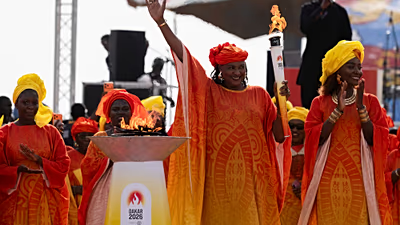
The Olympic flame was welcomed with music, dancing and a colourful procession in Senegal’s capital on Saturday, as 100 women marked the countdown to Africa’s first Olympic sporting event—the Youth Olympic Games.
More than 100 people gathered at Dakar’s Place du Souvenir Africain, a waterfront plaza overlooking the Atlantic Ocean and featuring portraits of prominent personalities from Africa and its diaspora, to welcome the flame ahead of next month’s Youth Olympic Games.
The Games, scheduled for October 31 to November 13, are expected to attract about 2,700 young athletes who will compete in 35 sports across Dakar and the neighbouring cities of Diamniadio and Saly.
First held in Singapore in 2010, the Youth Olympic Games are a scaled-down version of the Olympics for athletes between the ages of 15 and 18.
On Saturday, the flame was carried by 100 Senegalese women known as “lingeer,” a Wolof term traditionally used to refer to queens or women of royal status. The participants included prominent figures from Senegal’s cultural, sporting and business communities.
Clad in flowing orange and gold traditional outfits with yellow headwraps, the women carried the flame in a procession to the plaza, celebrating Senegalese women and symbolising the transfer of values from one generation to another.
Gacirah Diagne, one of the lingeer, said the Games would serve as an inspiration to young people across Africa, a continent with the world’s youngest population.
Senegalese basketball icon Mame Maty Mbengue had the honour of lighting the Olympic cauldron during the ceremony.
International Olympic Committee President Kirsty Coventry, who is from Zimbabwe, was also present at the event.
The flame departed Athens, Greece, on Thursday after being traditionally lit using the sun’s rays and a parabolic mirror. It was subsequently handed over to Senegal at the historic Panathenaic Stadium.
Beginning Monday, the flame will embark on a 3,600-kilometre journey across Senegal, passing through all 14 regions and carried by more than 400 Senegalese torchbearers before returning to Dakar for the official opening ceremony.