Ghana, Nigeria Pledge Deeper Cooperation to Boost Intra-African Trade and Advance ECO Currency
Ablakwa and Nigerian High Commissioner-designate commit to removing trade barriers, resolving investor concerns
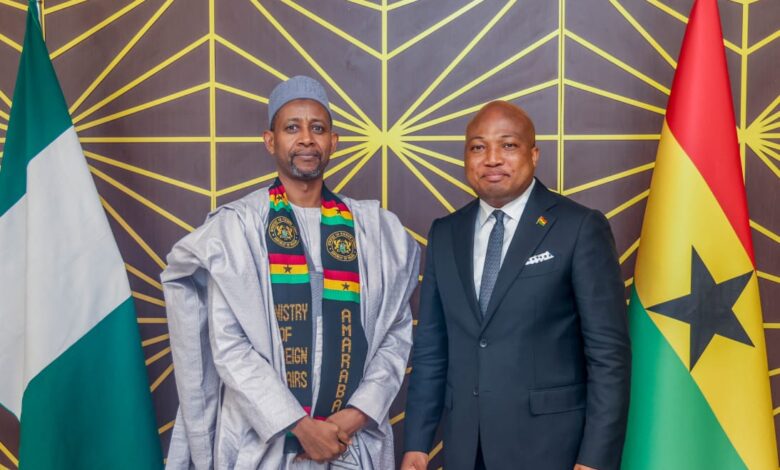
Ghana and Nigeria have resolved to deepen cooperation and strengthen cross-border trade as part of efforts to accelerate the goals of the African Continental Free Trade Area (AfCFTA).
The commitment was made in Accra when Minister for Foreign Affairs, Samuel Okudzeto Ablakwa, received open Letters from His Excellency Shehu ILU Barde, the High Commissioner-designate of Nigeria to Ghana.
The meeting comes at a time when both West African giants are under pressure to translate the promise of AfCFTA into tangible gains for traders, businesses and ordinary citizens.
Commitment to Remove Trade Barriers
Speaking during the ceremony, Mr. Ablakwa said Ghana and Nigeria must lead by example in removing bottlenecks that continue to slow trade between the two countries and across the continent.
“Both countries are committed to removing trade barriers to increase trade volumes beyond 20 percent,” the Minister stated. “Our people are trading every day at the borders, in the markets, and online. It is our duty as governments to make it easier, cheaper and faster for them.”
Trade between Ghana and Nigeria remains significant but below potential. Bureaucracy, inconsistent customs procedures, and non-tariff barriers have long been cited by business groups as obstacles.
The Minister noted that stronger cooperation will not only benefit the two economies, which are the largest in West Africa, but will also serve as a model for ECOWAS and the wider AfCFTA bloc of 54 countries.
He added that improving logistics, harmonizing standards, and digitizing trade documentation are key areas where both countries can work together immediately to unlock growth.
Push for the ECO Single Currency
A major part of the discussions focused on monetary integration in West Africa.
Mr. Ablakwa urged the Nigerian government and other ECOWAS member states to “bolster confidence in the launch of the single currency, ECO, for the subregion to facilitate trade.”
The ECO, first proposed decades ago, is intended to replace individual national currencies and reduce the cost of doing business across ECOWAS by eliminating currency conversion and exchange rate risks.
“A single currency will be a game-changer for traders in Aflao, Elubo, and at Seme Border,” Ablakwa said. “It will make prices more transparent, reduce transaction costs, and give our private sector the stability it needs to invest across borders.”
He called on Nigeria, as the region’s largest economy, to take a leading role in building the political and technical consensus needed to bring the ECO to reality.
Addressing Investor and Property Concerns
The Foreign Minister also used the occasion to raise concerns affecting Ghanaian investors in Nigeria.
Mr. Ablakwa urged the High Commissioner-designate to “look into the circumstances surrounding the properties of business mogul Sam Jonah, which have allegedly come under attack in Nigeria.”
The properties in question relate to Mobus Properties, owned by the Ghanaian businessman and Chancellor of the University of Cape Coast, Sir Sam Jonah. Reports of disputes and alleged attacks on the assets have caused concern within Ghana’s business community.
“We value the investments of Ghanaians in Nigeria and Nigerians in Ghana,” Ablakwa said. “It is important that we protect each other’s citizens and their legitimate businesses. That is how we build trust for deeper economic integration.”
Nigeria’s Response
In his remarks, High Commissioner-designate Shehu ILU Barde expressed appreciation to the Government of Ghana for the warm reception and commended the “longstanding friendly relations” between the two countries.
He described Ghana and Nigeria as “natural partners” whose cooperation is critical to the stability and prosperity of West Africa.
On the issue of trade, Barde assured that Nigeria remains committed to AfCFTA implementation and to working with Ghana to dismantle barriers that frustrate traders.
Regarding the Sam Jonah property matter, the High Commissioner-designate gave a firm assurance.
“I will take up and investigate the issues regarding Sam Jonah’s Mobus Properties in Nigeria,” he said. “Nigeria is a country governed by law, and we will ensure that the rights of all investors, including Ghanaians, are protected.”
Why This Matters for AfCFTA
Ghana and Nigeria together account for a significant share of ECOWAS’ population and GDP. When the two countries align on trade policy, it creates momentum for the rest of the subregion.
Analysts say the renewed pledge to push trade volumes beyond 20 percent and to fast-track the ECO could help address one of AfCFTA’s biggest challenges: low intra-African trade, which currently stands at about 15 percent compared to 60+ percent in Europe.
For businesses, the signals from Accra point to a renewed political will to fix border delays, harmonize regulations, and protect cross-border investments.
As the two countries mark another chapter in their diplomatic relations, both sides agree that cooperation is no longer optional.
“Our prosperity is linked,” Minister Ablakwa concluded. “Ghana and Nigeria must trade more, invest more in each other, and speak with one voice to make AfCFTA and the ECO a success for Africans.”