Ghana Must Stop Losing Value to Purity Loss—We’re Making Refining Work Inside the Country -GoldBod CEO Sammy Gyamfi
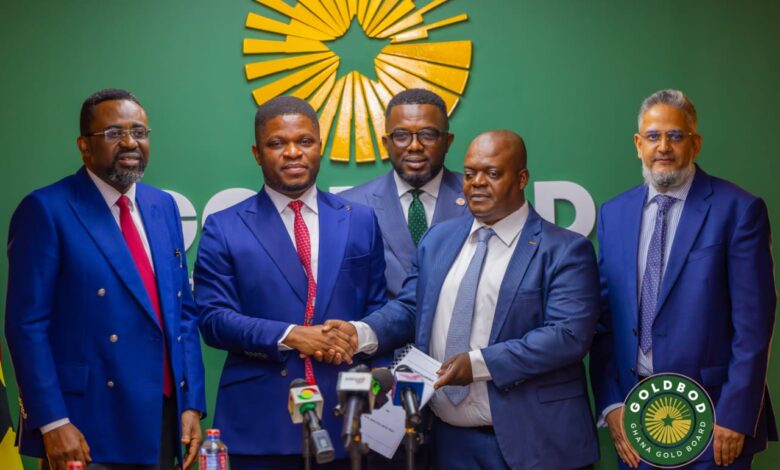
Sammy Gyamfi, Chief Executive Officer (CEO) of the Ghana Gold Board (GoldBod), has stressed that Ghana’s renewed push for local gold refining is not just an economic policy but an effort to protect the value of the nation’s resources at every stage of the gold supply chain. Speaking at the signing of a refinery services agreement between GoldBod and Royal Ghana Gold Refinery (RGGR), Mr. Gyamfi positioned the agreement as a practical solution to a challenge that has quietly cost Ghana: purity losses and avoidable disadvantages that arise when gold is processed outside the country.
While the Bank of Ghana Governor, Dr. Johnson Asiamah, presented the value-addition agenda largely through the lens of national balance of payments improvement—jobs, revenue, and better external accounts, the GoldBod CEO’s angle went deeper into the “how” behind the transformation. He argued that if Ghana is serious about benefiting fully from its mineral wealth, then the country must control the refining process to the extent possible, because the refining stage determines how much of the gold’s actual worth is retained and how much may be lost through quality deterioration, inefficiencies, or costly gaps in the chain.
Mr. Gyamfi’s message was clear: Ghana’s minerals should not only be mined in Ghana, but refined and secured in Ghana so that the nation captures the full value of what it produces rather than exporting raw material and importing back the benefits. In his view, local refining is the difference between simply participating in the gold economy and truly building a stronger national share of it.
He clarified that the new agreement is anchored on the conviction that local refinery services can prevent purity losses that sometimes occur when Ghana’s gold is refined externally. Purity, he noted, is not a technical detail but economic substance. When purity is not preserved, the final refined product can lose significant portions of its value. That loss may not always be visible at the point of export, but it ultimately shows up as reduced earnings to the country and to the entire value chain connected to production.
For that reason, he said GoldBod’s mandate is to change the narrative and the outcome. The policy push described widely as ending the export of raw minerals by 2030, requires more than announcements. It requires operational systems that ensure gold is processed domestically, and that processing happens at a scale that can move the national needle. Mr. Gyamfi argued that Ghana cannot rely on isolated or symbolic refining capacity; the country must establish a reliable framework that makes local refining the practical option for producers and stakeholders.
The GoldBod CEO anchored his remarks in a wider government direction that began to take shape after the President’s reset agenda gained momentum. He said the mandate was explicit: to reverse Ghana’s long-standing pattern of exporting raw minerals continuously, and instead build in-country capacity that allows value retention to become normal practice. Under this approach, GoldBod would not merely supervise the policy but would help operationalize it through partnerships that create real refining output.
He noted that prior to the recent policy shift, Ghana did not have functioning gold refineries capable of refining gold locally across meaningful levels, especially considering the mix of output from large-scale and small-scale mining. As a result, much of the gold produced in Ghana continued to be exported raw, leaving the country with fewer returns and less control over quality outcomes. That, he said, is precisely what GoldBod has been working to change.
Since com9ing into force of GoldBod, Mr. Gyamfi indicated that the Board has pursued measures intended to guarantee value retention. In his explanation, the goal is to create the conditions where refining can happen in Ghana through collaboration with investors and private entities that have made investments in refining infrastructure. He stressed that GoldBod’s approach supports eligible private participation while ensuring the process serves the national objective of keeping more value within Ghana’s borders.
To reinforce that this is not theoretical, Mr. Gyamfi referenced progress already recorded in the refining services framework. He mentioned that earlier this year, in February, GoldBod signed a refining agreement with Gold Coast Refinery intended to enable refining on a weekly basis. While he clarified that benchmarks were still being met operationally, meaning the capacity and output targets were a work in progress, and presented that partnership as evidence that Ghana’s refining ecosystem is being rebuilt through a pipeline approach rather than waiting for a single “big solution” to appear.
In that context, the agreement with RGGR is presented as another step in the same direction: expanding local refining opportunities and creating a system where more gold can be processed domestically with higher confidence in quality retention. Mr. Gyamfi said the target underpinning the agreement is to refine at least one metric tonne of gold weekly, depending on the refinery’s capacity and operational readiness. By focusing on weekly refining at meaningful scale, he implied, the strategy aims to ensure local refining becomes a regular part of Ghana’s gold economy rather than an occasional service.
Crucially, the CEO’s comments also reflected a belief that the benefits of local refining go beyond the final export figure. He argued that when Ghana refines its gold at home, it strengthens domestic industries and creates wider economic activity directly in refining, indirectly across logistics, compliance, quality assurance, and employment. But he returned repeatedly to the central point: purity losses must be reduced, because purity-related loss is a loss of value that can undermine the entire national value-addition drive.
He also suggested that GoldBod is not treating this as a temporary arrangement. He described future plans to scale up by building additional refineries capable of refining the volume of gold being produced in Ghana. Mr. Gyamfi highlighted that Ghana’s annual gold output from both small-scale and large-scale mining is over 200 metric tons, demonstrating that Ghana has the resources necessary to sustain more intensive refining activity domestically. If Ghana can refine more of that output within its borders, then the country stands to capture far greater economic value over time.
In his view, local refining is the gateway to building a more stable and profitable gold value chain for Ghana. It reduces reliance on external refining arrangements that may not always align with Ghana’s quality and economic interests. It also creates a foundation for Ghana’s longer-term goal of ending the export of raw minerals—because without domestic refining capacity, value-addition ambitions remain difficult to achieve.
As Mr. Gyamfi framed it, the agreement with RGGR marks progress on multiple fronts: operational capacity, quality retention, and a renewed commitment to protecting the value of Ghana’s gold. But the most forceful takeaway from his statement is also the most practical: Ghana’s minerals must be refined and secured within Ghana to prevent avoidable losses. If purity is protected, value is retained. And if value is retained, Ghana’s economy benefits in measurable ways—through jobs, revenue, and ultimately a stronger national financial position.
In short, Mr. Gyamfi’s “purity and value retention” angle reframes the refinery agreement as something more than a contract. To him, it is a decisive step toward ensuring that Ghana stops losing money quietly at the refining stage, and starts building a gold value-addition model that works for the country, not just for export markets.