NHIA Calls for Stronger Collaboration and Domestic Financing to Tackle Maternal and Child Malnutrition
The National Health Insurance Authority has urged government agencies, development partners, and civil society to align efforts and increase domestic investment in maternal and child nutrition, warning that fragmented interventions are failing Ghana’s most vulnerable families.
Speaking at a high-level breakfast meeting hosted by Women, Media and Change [WOMEC] on Thursday, NHIA Deputy CEO for Finance and Investment, Madam Anatu Anne Seidu Bogobiri Esq., said malnutrition cannot be solved by one institution working alone.
“At NHIA, we believe healthcare must go beyond treating illness. We must also invest in prevention and early intervention,” she told parliamentarians, health professionals, traditional leaders, and media gathered at the Coconut Grove Regency Hotel.
Nutrition as a national issue, not just medical
Bogobiri said nutrition touches every part of national life, from schools and the economy to families and the country’s future. She highlighted the daily struggles of mothers and children in Ghanaian communities, citing frontline health workers who manage with limited resources and mothers forced to choose between feeding their families and seeking care.
“These are not statistics on paper. These are real Ghanaian families,” she said.
She warned that when a child suffers from malnutrition today, the country pays tomorrow through poor educational outcomes, reduced productivity, and higher healthcare costs.
“Investing in nutrition is one of the smartest investments any country can make,” she added.
NHIS role and financing gaps
Bogobiri outlined NHIS support for maternal healthcare under the Free Maternal Healthcare Policy, covering antenatal care, delivery, and postnatal care. While nutrition is not yet a standalone benefit, pregnant women receive nutrition education and counselling during ANC visits, and prescribed supplements for conditions like anemia and vitamin deficiency are covered as part of treatment.
Under the Free Primary Healthcare initiative, nutrition promotion and education are expected to play a stronger role, though routine nutritional products and feeding support remain uncovered.
She said NHIA is interested in conversations around sustainable financing for interventions such as Ready-to-Use Therapeutic Food and Multiple Micronutrient Supplements, stressing that “we cannot continue depending only on temporary support or fragmented interventions.”
Call for alignment and political commitment
Beyond financing, Bogobiri stressed the need for better coordination and data sharing across institutions.
“Sometimes in our system, everybody is working hard, but not always in the same direction,” she said. “Meanwhile, the mother in the community simply wants accessible and reliable care.”
She called for stronger collaboration between government agencies, development partners, civil society, and the private sector, along with clearer priorities and sustained domestic commitment to maternal and child nutrition.
“No child should suffer the long-term effects of malnutrition simply because support came too late or because systems failed to work together,” she said. “No mother should be left behind because essential interventions are financially out of reach.”
WOMEC meeting targets parliamentary action
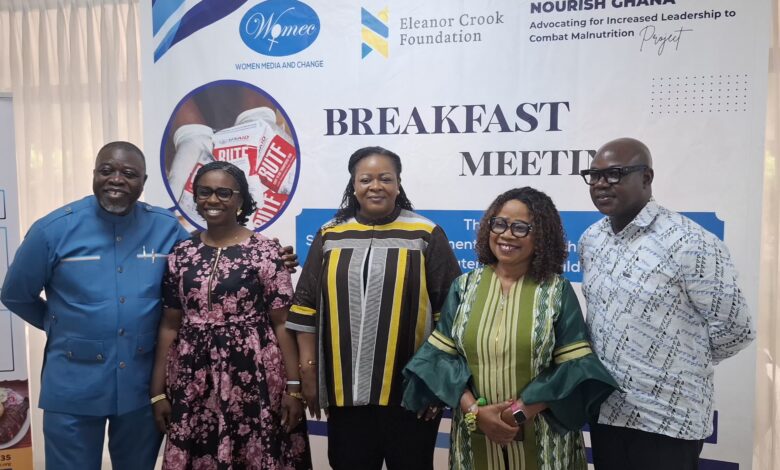
The breakfast meeting, organized by WOMEC, brought together parliamentarians and stakeholders to discuss Parliament’s role in closing the nutrition financing gap, increasing domestic budgetary allocation for nutrition-specific interventions, and strengthening accountability for Ghana’s Nutrition for Growth commitments.[N4G]
WOMEC Executive Director Dr. Charity Binka said the media’s role in shaping public discourse and amplifying advocacy is critical to driving action.
Bogobiri concluded by urging participants to leave with “a renewed sense of urgency and shared responsibility,” adding that “the work ahead is important, and the time to act is now.”