NDPC Holds Validation Meeting on Draft 2025 Annual Progress Report
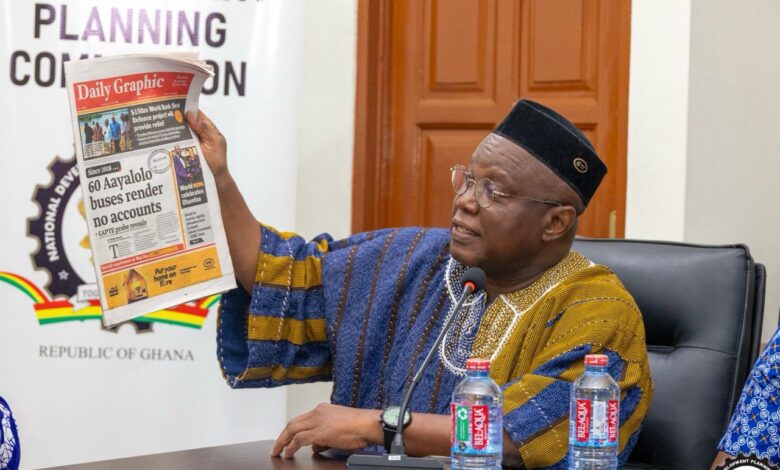
The National Development Planning Commission (NDPC) has commenced a three-day validation meeting today, Monday, 18 May 2026, on the draft 2025 National Annual Progress Report (APR), bringing together representatives from Ministries, Departments and Agencies (MDAs), Regional Coordinating Councils (RCCs), Metropolitan, Municipal and District Assemblies (MMDAs), development partners, and students to review progress under Ghana’s 2022–2025 Medium-Term National Development Policy Framework.
In his opening remarks, Mr Richard Tweneboah-Kodua emphasised the importance of stakeholder collaboration and evidence based reporting in national development planning. He noted that the Annual Progress Report has remained a key accountability tool since its introduction under the Fourth Republican Constitution. According to him, “The Annual Progress Report serves as an important instrument for measuring Ghana’s progress in implementing nationally agreed development plans. It also enables us to track our commitments under regional, continental, and global development frameworks and protocols.”
He explained that the work of institutions extends beyond data collection and reporting, stating that “the information we generate contributes to improved healthcare delivery, better livelihoods, stronger businesses, enhanced environmental management, and more efficient public services.”
Mr Kodua commended MDAs, RCCs, and MMDAs for their continued support to the APR process over the years. He noted that the 2025 reporting cycle presents a learning opportunity ahead of the new 2026 to 2029 Medium Term Development Framework. He stated that “this final reporting cycle under the current framework should help us refine our indicators, strengthen data quality, improve timeliness, and enhance overall reporting systems going forward.”
The Chairman of the Commission, Dr Nii Moi Thompson, in his keynote address, urged participants to move beyond routine reporting and place greater emphasis on impact, performance, and productivity. He stated that although Ghana has consistently developed plans and produced Annual Progress Reports, implementation gaps continue to constrain national transformation. He added, “It is not enough to go through the motions or fulfil procedural requirements. We must be equally concerned about the actual results and impact of our efforts.”
Dr Thompson referred to Monitoring, Evaluation and Learning, highlighting the need for stronger feedback mechanisms to improve policy implementation and outcomes. He noted that several long term development strategies, including the 40 Year Development Plan, Ghana Beyond Aid, Ghana at 100, and Vision 2057, had not been fully implemented. “The challenge is not the absence of plans. The challenge is implementation,” he emphasised.
He also stressed the role of strong institutions, discipline, and productivity in achieving sustainable development. According to him, “Without the right attitudes, discipline, accountability, and work ethic, even well designed policies and development plans may not deliver the desired results.” He identified electricity, water, transport and logistics, and digital infrastructure as key pillars for Ghana’s industrialisation and competitiveness.
The Director of Monitoring and Evaluation, Mr Bright Attiase, highlighted the growing importance of the APR process and increased parliamentary scrutiny. He cautioned institutions against delays in submitting reports, noting that the process can no longer be treated as routine.
He disclosed that some institutions had already been invited to appear before Parliament’s Select Committee on Economy and Development Parliament of Ghana to account for the implementation of their 2024 plans and programmes. He added that the Commission will strengthen quarterly engagements with planning and monitoring officers to improve coordination, accountability, and tracking of implementation.
He also stated that only 28 institutions had submitted their reports out of the expected number, with 10 still outstanding. He indicated that stronger enforcement measures would be considered for institutions that continue to default on reporting requirements.
The Chief Analyst of the Commission, Mr Isaac Ewoe, guided participants through the APR preparation process and outlined expectations for the syndicate group discussions. He stressed the need to link data and indicators to policy outcomes and development objectives.
He stated that “as participants review the reports, they are expected not only to present the data, but also to explain the implications of the findings for the goals and objectives outlined in the policy framework.” He added that each indicator must have a corresponding target and baseline to enable effective assessment of institutional performance.
He emphasised that “these reports must reflect the true realities and lived experiences of Ghanaians. There should be no disconnect between what is documented and what citizens experience on the ground.”
The meeting concluded with participants breaking into four syndicate groups to review sector specific findings, assess data quality, validate indicators, and make recommendations for the finalisation of the 2025 National Annual Progress Report.