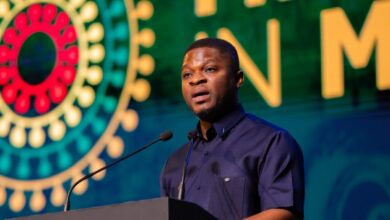
Airport Levy Risks Disconnecting Ghana’s Youth and Diaspora-Kwaku Ampratwum Djarbeng
Source: Kwaku Ampratwum Djarbeng

The introduction of new airport infrastructure levies in Ghana as of April 1, 2026, represents a policy decision that sits at the intersection of development ambition and economic sensitivity. On the surface, the rationale is compelling. Modern airport infrastructure is a strategic asset. It enhances national image, boosts tourism, improves safety standards, and positions Ghana as a regional aviation hub. In a global economy where connectivity defines competitiveness, investment in aviation infrastructure is very essential.
However, the mechanism chosen to finance this ambition raises critical concerns, particularly when examined through the lens of youth mobility, diaspora engagement, and broader economic multipliers.
The immediate effect of the levy is a direct increase in the cost of travel to and from Ghana. For international travellers, especially those from the diaspora in places like the United Kingdom, an additional $100 on intercontinental tickets is not trivial. Air travel is already price-sensitive, and Ghana competes with multiple destinations across Africa and beyond for diaspora visits, tourism, and business travel. When costs rise disproportionately, travellers do not simply absorb them but adjust their behaviour. This is a well-documented principle in aviation economics — _demand for air travel is elastic, particularly for leisure and diaspora travel segments_.
From a youth perspective, this is even more consequential. Young Ghanaians in the diaspora, that is, students, early-career professionals, and young families, are among the most price-sensitive travellers. These are individuals who are still building financial stability but are also the most important demographic for sustaining long-term cultural and economic ties to Ghana. Increasing the cost of travel risks weakening that connection. Visits home become less frequent, shorter, or postponed altogether. Over time, this has deeper implications for identity, remittance flows, and investment behaviour.
Comparatively, global best practices suggest that while airport development is often partially funded through user charges, successful aviation hubs carefully calibrate these fees to remain competitive. Airports such as those in Dubai, Istanbul, and Kigali have pursued aggressive infrastructure expansion, but they balance this with policies that incentivize traffic growth. In many cases, governments absorb a larger portion of infrastructure financing or structure fees in a way that does not deter volume. The logic is simple. Higher passenger throughput generates more cumulative revenue across the economy than high charges on fewer travellers.
In contrast, Ghana’s current approach risks prioritizing immediate revenue collection over long-term traffic growth. If fewer people travel, the downstream effects are significant. Reduced arrivals mean lower spending in hospitality, transportation, retail, and tourism services. Hotels experience lower occupancy rates, local businesses lose customers, and informal sector actors, from taxi drivers to market traders, see reduced income. The aviation levy, therefore, cannot be viewed in isolation, as it has ripple effects across the entire economic ecosystem.
There is also a competitiveness issue. Within West Africa, Ghana has positioned itself as a preferred destination for conferences, cultural tourism, and diaspora return initiatives such as “Year of Return” and “Beyond the Return.” These initiatives were successful partly because they lowered barriers and created incentives for travel. Introducing higher costs risks eroding that competitive edge, especially when alternative destinations offer comparable experiences at lower overall travel costs.
That said, the policy’s underlying objective should not be dismissed. The need for modern, efficient, and scalable airport infrastructure is undeniable. The challenge, therefore, is not whether to invest but how to finance that investment in a way that aligns with broader economic goals.
A more balanced approach would involve a phased or tiered implementation of levies, allowing the market to adjust gradually rather than imposing a sharp cost increase. Additionally, the government could explore blended financing models that combine public investment, private sector partnerships, and concessional funding, thereby reducing the burden on travellers. Transparency is also critical. When citizens and the diaspora clearly understand how funds are being used and see tangible improvements, there is greater willingness to accept incremental costs.
Another important recommendation is to differentiate between traveller categories. Incentives or reduced levies for students, young professionals, and frequent diaspora travellers could help maintain engagement with younger demographics. Similarly, policies that encourage airlines to increase routes and competition can help offset cost increases through lower base fares.
From a youth advocacy standpoint, this issue provides an opportunity to demonstrate leadership that is both critical and constructive. The role of a youth organiser, particularly within the NPP-UK context, is not merely to echo policy but to interrogate its impact on young people and propose viable alternatives. This means advocating for policies that strengthen connectivity without excluding the very demographic that will drive Ghana’s future.
Ultimately, the question is one of balance. Ghana must build for the future, but it must do so in a way that keeps the door open, financially and psychologically, for its youth and diaspora. If travel becomes a luxury rather than an accessible bridge, the country risks losing not just visitors but long-term partners in development.
Positioning yourself around this issue, therefore, is not about opposition but about ensuring that infrastructure development does not come at the cost of inclusion, and that economic policy reflects an understanding of how interconnected travel, youth engagement, and national growth truly are.