Ghana targets 100% local gold refining as Mahama champions value addition
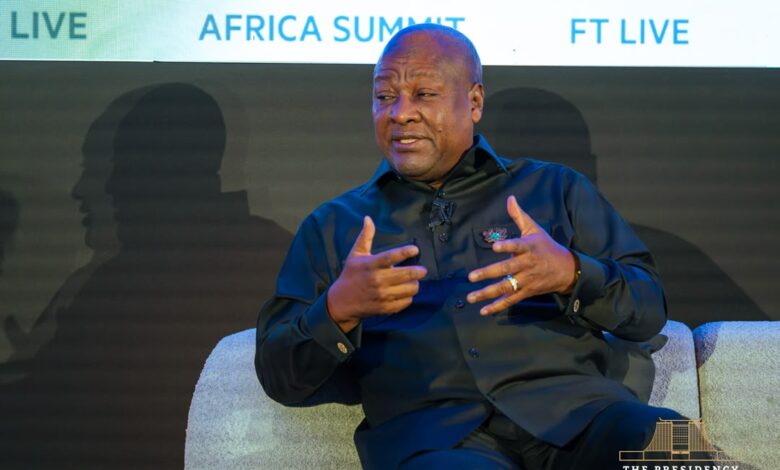
President John Dramani Mahama has announced plans to refine all of Ghana’s gold locally before export, as part of efforts to increase value addition, create jobs and maximise the economic benefits of the country’s mineral resources.
Speaking at the FT Africa Summit in the United Kingdom, President Mahama said Ghana had made significant progress in domestic gold refining, with approximately 70 per cent of its gold now refined locally before being exported.
He said the government intended to build on the progress to ensure that more of the value generated from the country’s mineral wealth remained within the domestic economy.
“We have done marvellously with gold. Seventy per cent of our gold is currently being refined in Ghana before it is exported, instead of digging out the raw bullion and exporting it to be refined somewhere else,” he stated.
President Mahama expressed confidence that Ghana could achieve full local refining, while also expanding its downstream jewellery industry to increase the range of gold products exported to international markets.
“We are increasingly refining our gold, and I am sure that soon we will refine 100 percent of it. We are also looking at expanding the downstream jewellery industry so that we can export jewellery,” he said.
The President’s remarks form part of a broader government agenda to move Ghana away from exporting raw materials towards processing and manufacturing products locally.
He argued that Africa could no longer afford to remain a supplier of raw materials to the global market while importing finished products, particularly when the continent had the resources and human capital needed to develop its own industries.
“We cannot continue forever as exporters of raw materials to the rest of the world and consumers of finished products. We must bring part of that processing and value addition into Africa to create jobs for our young people,” he said.
Beyond gold, President Mahama identified lithium, manganese and bauxite as minerals with significant potential for local processing and industrial development.
He noted that Ghana continued to export raw bauxite while importing alumina, despite having an aluminium smelter that processes alumina into aluminium for export.
“The only missing link is that we do not have an alumina refinery. Any investor willing to work with us to establish one would benefit from the value addition that takes place in the aluminium value chain,” he said.
President Mahama added that the government had set 2030 as the target date for ending exports of raw ores, although implementation would be sequenced according to the specific requirements of each mineral.
“The target date to stop the export of raw ores is 2030, but we will sequence the process. It depends on the particular mineral,” he stated.
The President stressed that greater local processing would benefit both Ghana and investors by creating employment, strengthening local economies and improving the security of investments.
He argued that mining investments could not thrive sustainably when surrounding communities remained impoverished despite the extraction of valuable natural resources.
“It is in the investor’s interest to have a safe environment. You cannot have prosperity in the midst of poverty. That itself is a danger to investments,” he said.
President Mahama also highlighted the government’s cocoa-processing policy, which seeks to ensure that at least 50 per cent of Ghana’s cocoa beans are processed locally.
He said the broader value-addition agenda was intended to transform the country’s export structure, expand industrial capacity and provide more employment opportunities for young people.
The President urged international investors to partner with Ghana in establishing processing facilities, emphasising that the country remained open to investment from all parts of the world.
He maintained that cooperation between government and the private sector would be essential to achieving Ghana’s industrialisation ambitions and ensuring that the country derives greater benefits from its natural resources.