President Mahama unveils $20bn development vision through Big Push and new economy plans
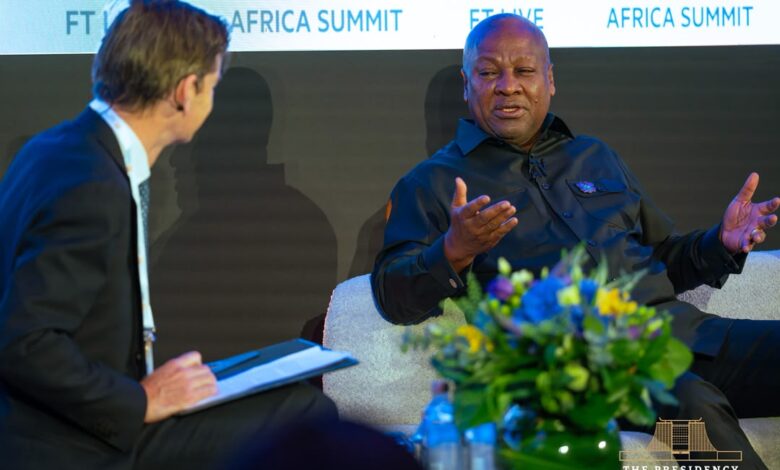
President John Dramani Mahama has outlined a $20 billion development vision for Ghana through the Big Push infrastructure programme and a new economy plan aimed at expanding infrastructure, creating jobs and strengthening the country’s economic resilience.
Speaking at the FT Africa Summit in the United Kingdom, President Mahama said the two programmes would be financed through domestic resources, demonstrating his government’s determination to mobilise local funds to drive development and reduce dependence on external financing.
The Big Push programme is expected to receive $10 billion over five years, with an annual allocation of $2 billion. The initiative, which began with road infrastructure, will be expanded to include schools, hospitals, irrigation schemes and other critical development projects.
“We are building infrastructure through the Big Push Programme. It is a $10 billion programme over five years, with $2 billion allocated each year,” President Mahama said.
He explained that the government’s economic reforms had helped improve expenditure management and create room for investment in sectors considered essential to Ghana’s development.
“This year, the Finance Minister is going to launch the new economy plan. It is also self-financed and will involve another $10 billion, this time over four years,” he stated.
The new economy plan will target nine job-rich sectors, including tourism, energy, agriculture, agro-processing, pharmaceuticals, textiles and garments. The government expects investments in these areas to expand local production, create employment opportunities and strengthen the country’s productive capacity.
President Mahama said the additional resources for the programme would partly come from changes to the country’s primary balance target under its agreement with the International Monetary Fund (IMF).
“During the IMF period, it was 1.5 percent. We have agreed with the IMF to reduce it to 0.5 percent. The additional fiscal space of one percentage point will go into the sectors I have mentioned,” he said.
According to the President, the adjustment forms part of a broader strategy to ensure that Ghana’s economic recovery translates into tangible development outcomes for citizens.
He said the government had introduced reforms to strengthen public financial management, improve procurement processes and control public expenditure, allowing more resources to be directed towards national priorities.
“We did a lot of streamlining that has enabled us to control expenditure. We are realising that it is freeing up substantial resources to invest in the priorities that matter to us,” he added.
President Mahama also highlighted Ghana’s transition from the IMF’s Extended Credit Facility programme to the Policy Coordination Instrument, noting that the latter does not provide direct financing.
He said the country must increasingly rely on its own capacity to finance development, arguing that efforts to establish a new global economic order must begin with responsible management of domestic affairs.
“I keep saying that even as we call for a new order and seek to break the dependency syndrome, it must start with how we manage our own affairs,” he said.
The President further pointed to Ghana’s economic performance amid global disruptions, including tensions in the Middle East, as evidence of the progress made through domestic reforms.
“With the disruption taking place, including the crisis in the Middle East, we still have inflation at about 5 percent,” he said, adding that the currency remained stable and interest rates continued to fall.
He maintained that the combined investments under the Big Push and new economy plans would help Ghana build stronger infrastructure, stimulate industrial growth and create sustainable employment opportunities, particularly for the country’s youthful population.