EXTERNAL NPP BRANCHES SLAM TUC OVER DUAL CITIZENSHIP STANCE: “You Can’t Take $7.8bn And Tell Us We’re Not Ghanaian Enough”
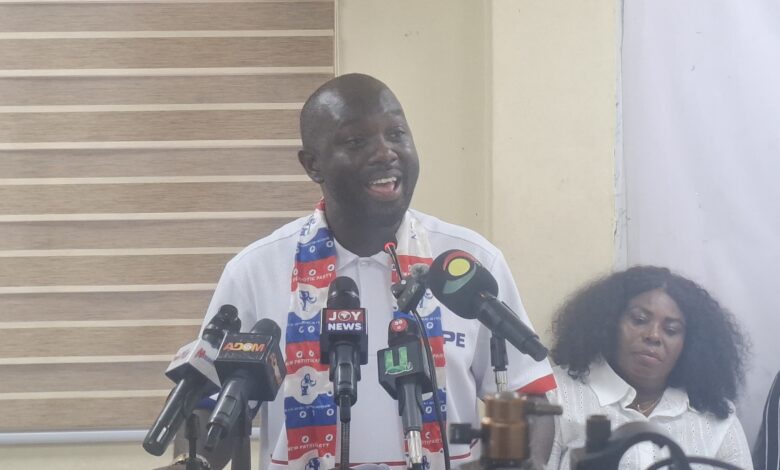
The External Branches of the New Patriotic Party (NPP) have launched a fierce rebuttal to the Trades Union Congress (TUC) over its opposition to the Constitutional Review Committee’s recommendation to allow dual citizens to contest parliamentary elections and hold political offices including Minister of State.
At a press conference addressed by the NPP UK Branch Chairman, Andy Owusu, the Diaspora wing of the party described the TUC’s position as legally illiterate, economically suicidal, and morally inconsistent.
On 9th September 2026, the General Secretary of the TUC, Mr. Joshua Ansah, was quoted as saying: “The TUC disagrees with recommendation to amend Article 94(2) to allow U.S. citizens to contest parliamentary elections and become members of Parliament while remaining a citizen of another country. In fact, we characterize the recommendation as self-serving and a direct assault on genuine citizenship. It is contradictory and serves no useful purpose for the country.”
But the External Branches say that statement is rooted in outdated fears and not facts.
Historical Fear, Not Principle
Giving a historical background, Mr. Owusu explained that the 1992 Constitution did not initially recognise dual citizenship because the framers, operating in the shadow of the PNDC era, feared Ghanaians who had fled abroad would return to topple the Rawlings-led NDC government.
That argument was later defeated. On 28th December 1996, after the NDC had secured its second term, Act 527 was assented to, recognising dual citizenship for the first time.
“This was a progressive step, but an incomplete one,” the statement noted.
The party recalled that Section 16(2) of the Citizenship Act, 2000 (Act 591) which barred dual citizens from becoming Chief Justice, Commissioner of VAT Service, Director-General of Prisons, Chief Fire Officer, Chief Director of a Ministry, and Colonel in the Armed Forces, was declared unconstitutional by the Supreme Court on 24th April 2024 in the case of Francis Osei-Bonsu v Attorney General [J1/18/2023] by a 6-1 majority.
“If we can now trust a dual citizen to be Chief Justice, as the Supreme Court now allows, why can we not trust the same citizen to be a Member of Parliament?” Mr. Owusu quizzed.
Passport Is Not Allegiance
Correcting what he calls a misplaced narrative about allegiance, the NPP UK Chairman, himself a dual citizen holding senior public responsibilities in the United Kingdom, argued that a passport acquired through naturalisation is not evidence of divided loyalty.
“A passport acquired through naturalisation is not evidence of divided loyalty. It is, for most, a travel and work document. In law, it is not different from Indefinite Leave to Remain in the UK, a Green Card in the US, or a permanent residence permit elsewhere. The only practical difference is visa-free travel, a system heavily rigged against African states,” he stated.
He added that the UK itself can strip a naturalised citizen of the right to enter without notice, and that persons holding permanent residency have been eligible for public office in Ghana since 1992 without any problem.
“Patriotism is not in the passport, it is in the heart. An oath of allegiance cannot be limited to nationality. It is the oath of office that binds a public officer. History shows us that those convicted of espionage and corruption against Ghana have overwhelmingly been single-citizenship holders,” he stressed.
The External Branches cited over 32 African countries including Kenya, Nigeria, Sierra Leone, Liberia, and Rwanda that have removed similar restrictions and have leapfrogged Ghana because they treat their diaspora as a strategic resource.
They also commended the NPP for its progressive stance, recalling that in the last Parliament, Hon. Kennedy Osei Nyarko, MP for Akim Swedru, introduced a Private Member’s Bill seeking to remove the restriction.
The $7.8 Billion Economic Punch
Moving beyond law and emotion, the External Branches delivered a strong economic argument.
According to the Bank of Ghana, Ghana received $6.65 billion in remittances in 2024, up from $5.11 billion in 2023. By end of 2025, Governor Dr. Johnson Pandit Asiama confirmed remittances had reached nearly $7.8 billion – approximately 6% of GDP.
The figures are staggering:
Remittances now exceed Foreign Direct Investment by over $4.9 billion ($6.65bn vs $1.73bn in 2024)
In the last decade (2014-2023), Ghana received $28.6 billion in remittances, more than the $18.7 billion earned from cocoa exports
Remittances are now Ghana’s second-largest foreign exchange earner after gold
Quoting the Governor in Virginia in April 2026, they said: “The Ghanaian diaspora is not peripheral to our economy. You are central to our external stability, to our investment strategy, and to our economic transformation agenda.”
“Can we continue to take $7.8 billion a year from a people and tell them they are not Ghanaian enough to serve? That is taxation without representation,” the statement fired.
Second-Class Ghanaians and Year of Return Hypocrisy
The External Branches also raised a moral question about second-generation Ghanaians born in London, Toronto, Hamburg or New Jersey by circumstance, not by choice, who bear Ghanaian names, speak local languages, and want to serve, but are told they are second-class Ghanaians.
“We are losing a generation not because they lack love for Ghana, but because Ghana appears to lack love for them,” Mr. Owusu lamented.
They further accused the state of hypocrisy – inviting diaspora Africans under Year of Return and Beyond the Return, granting citizenship to global icons like Stevie Wonder and Idris Elba, and expecting their capital and skills, but forbidding them from having a voice in governance.
“You cannot invite someone to build the house and then forbid them from entering the living room. We cannot celebrate them as Ghanaians when they remit and invest, and then reject them as foreigners when they offer to serve. That is inconsistent. It is exploitative,” the statement said.
The press conference ended with a clarion call: “We are all Ghanaians. Whether born in Kumasi or Cologne, whether holding one passport or two, Ghanaian blood is Ghanaian blood. The Black Star cannot shine fully if we deliberately dim half its light. Let us amend Article 94(2) and affirm that once a Ghanaian, always a Ghanaian.”