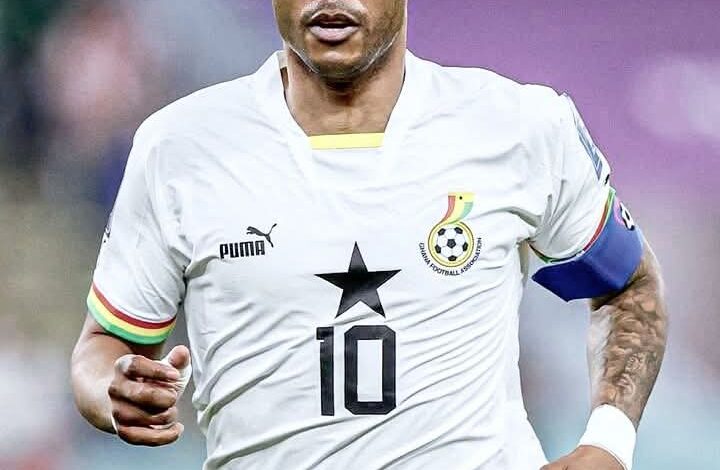
The footballing achievements of André “Dede” Ayew are historic, both for Ghana and on the international stage.
But his greatest contribution to Ghanaian football may yet extend beyond his playing career.
Having now taken on the role of Chief Executive Officer of FC Nania, Ayew is already a transit from being a footballer on the pitch to a football administrator.
His career offers Ghana an important opportunity to ask a larger question:
Should some of Ghana’s most accomplished footballers become part of the country’s future football leadership?
The answer is definitely yes – provided they are prepared, equipped with football administrative knowledge and assessed on merit.
A Career Built on Service, Dedication, Experience and Leadership:_
André Ayew began a remarkable international journey
early.
He represented Ghana at the 2008 Africa Cup of Nations at just 18 years of age and went on to become one of the most experienced players in the history of the Black Stars of Ghana.
At youth level, he captained Ghana’s historic 2009 FIFA U-20 World Cup-winning team.
Ghana’s victory over Brazil in Egypt made the Black Satellites the first ever African team to win the FIFA U-20 World Cup.
Ayew was not only a member of that historic team; he was an inspirational captain on his side.
The 2009 FIFA U-20 World Cup-victory significantly, demonstrated an early capacity for leadership that carried enormous national and continental expectations.
At the Ghana’s men senior level, Ayew international appearance record reached 110 caps in November 2022.
His Africa Cup of Nations record is equally exceptional:_
Ayew made 36 appearances at the AFCON Finals across eight editions – 2008, 2010, 2012, 2015, 2017, 2019, 2021 and 2023.
His 36 AFCON finals are tied with Cameroon legend Rigobert Song for most matches played.
He also belongs to the distinguished group of players who have scored in six different AFCON tournaments.
That is to say – he has demonstrated an extraordinary combination of consistency and performance at the highest level of African football.
At the 2015 AFCON Finals, Ayew finished as the tournament’s leading scorer with three goals and also recorded the highest number of assists, earning him the official top – scorer award.
These achievements are not simply statistics:_
They represent years of dedicated exposure to:
– National-team responsibility,
– Different coaches,
– Tactical systems,
– Dressing-room cultures,
– Professional environments and the
– Pressures that accompanied representing Ghana.
He has indeed, selflessly sacrificed for his motherland Ghana.
From Player to Football Administration:_
The transition from a footballer to football administrator should
not disappear from the football ecosystem once a player’s career begin to wind down.
The real interest should be how their experiences can be converted into institutional knowledge to promote the development of football.
André Ayew, in this scenario presents an interesting case because his football journey is already extended beyond the pitch.
In August 2026, he publicly confirmed that he has served as CEO of FC Nania for several years – FC Nania, which competes in Ghana’s Division One League, founded by his father – the Ghanaian football legend Abedi “Pele” Ayew.
His role in FC Nania – enriches Ayew practical experience in areas that are fundamentally different from playing football such as:
– Administration,
– Club management,
– Development structures,
– Talent identification,
– Organisational leadership,
– Stakeholder relations and the
– Business of football.
Ghana should eargely encourage and develop a pathway for players from playing to leadership:_
Ghana should deliberately re-think about the transition of successful players into football leadership, because they already understand the complexities of football.
Identified players with potential football governance talents should be encouraged to acquire more:
– football administrative, financial and organisational management skills;
– football youth academy development;
– sports law and regulatory knowledge;
– communications and stakeholder management; and
– CAF and FIFA governance frameworks.
In fact, there is a powerful symbolism in moving from the football field to the leadership table.
Dede has worn Ghana’s national colours for many years, captained the Black Satellites to a historic FIFA U-20 World Cup triumph, captained the Black Stars, competed at the AFCON and FIFA World Cup, experienced club football across different countries and cultures, and now has direct involvement in club administration, therefore, possesses perspectives that cannot be acquired solely in a boardroom.
Dede therefore understands the game from the dressing room, training ground, football pitch, national-team camp and professional club environment.
That perspective, indeed – matters.
Africa needs football administrators who understand not only the commercial and institutional dimensions of the game, but also the human realities of footballers – the pressures on players, the aspirations of young talent, the challenges facing national teams, the importance of academies at the grassroots, and the responsibility that comes with representing a national Flag and Anthem.
André Ayew is therefore not simply a former or current footballer with an impressive résumé but a practitioner in the field of football.
He is potentially part of a new generation of Ghana and African football professionals who can bridge the gap between football experience and football governance.
The Case for Considering ANDRÉ AYEW:_
Once again a look at Ayew’s case for future football leadership – resting on a combination of achievements, experienced and emerging administrative involvement:
– 36 AFCON finals appearances, a competition record shared with Rigobert Song;
– Eight AFCON tournament appearances, among the competition’s all-time record holders;
– Captain of Ghana’s historic 2009 FIFA U-20 World Cup-winning team;
– More than 100 men senior team international appearances and Ghana’s record men’s international appearance holder;
– 2015 AFCON leading scorer, with three goals, alongside the tournament’s leading assist tally;
– Long-standing Black Stars leadership and captaincy;
– Experience across major professional football environments in Europe and beyond;
– Current involvement in football administration as CEO of FC Nania;
– A demonstrated connection to youth and grassroots football through the FC Nania football structure; and
– A deep understanding of Ghana’s national-team environment which has been accumulated over nearly two decades.
Taken together, these experiences make him worthy of serious consideration in the next generation of Ghanaian football leadership.
_But the Principle must go beyond ANDRÉ AYEW:_
The argument is not that André Ayew deserves a leadership position simply because he is famous.
The larger principle is that Ghana must build a deliberate leadership pipeline for its football professionals:
– André Ayew is considered one of the leading examples.
Other accomplished Ghanaian footballers – including former national-team captains and players with substantial international experience – should similarly be encouraged to prepare themselves for careers in coaching, scouting, technical development, club administration, sports governance and football diplomacy.
The transition should be based on:
– merit,
– competence,
– integrity,
– preparation and
– demonstrated leadership.
There is an important distinction between entering football just as a business opportunity and entering football as a responsibility to develop the game.
The next generation of football leaders must also understand that the “art of football” is not an entertainment industry alone, it is:
– a national institution,
– a youth-development platform,
– a source of employment,
– a vehicle for national unity and
– an important part of Ghana’s international image.
Hence, those who have lived the game at the highest level can bring something valuable to that institutional mission and message.
For André “Dede” Ayew, the next chapter could be more than a retirement from football:_
It could be a transition from playing for Ghana to helping shape the future of Ghanaian football – and, potentially, one day, not only contribute to the leadership of African football but that of the world itself with his fluent bilingual strength.
Long Live the good spirit of Ghana and Africa Football.
Benjamin Anyagre Aziginaateeg,
Leader
AfriKan Continental Union Consult (ACUC),
AfriKan Province – Ghana.