Every cedi invested in SOEs must create public value- President Mahama
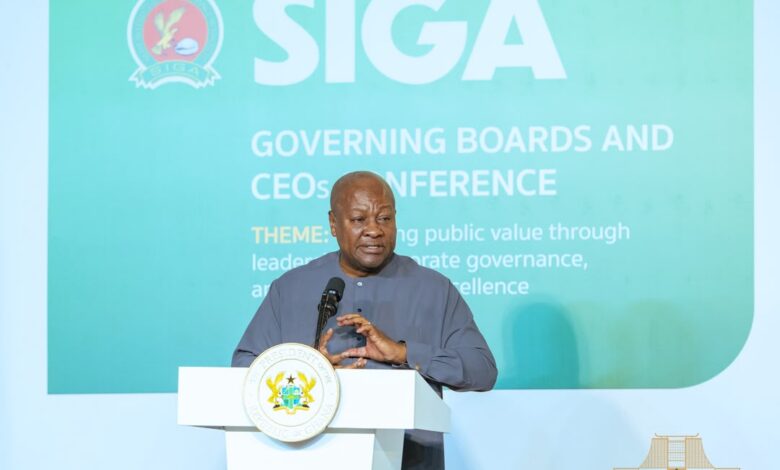
President John Dramani Mahama has charged governing boards and chief executives of state-owned enterprises (SOEs) to ensure that every cedi invested by the state delivers measurable value to the people of Ghana.
He said public resources and assets entrusted to state-owned enterprises must be managed responsibly and efficiently to generate tangible economic and social benefits for citizens.
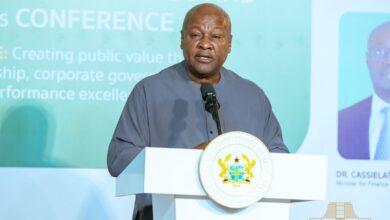
Addressing the 2026 SIGA Governing Boards and CEOs’ Conference, President Mahama stressed that the performance of SOEs could no longer be judged merely by their ability to remain operational, pay salaries or meet routine obligations.
“The test is whether it creates value that a farmer, trader, worker, entrepreneur or student can experience,” he said.
According to the President, the assets managed by SOEs—including ports, power facilities, factories, water infrastructure, pension funds, lands, buildings, equipment and shares held by the Republic—belong to the people of Ghana.
“These assets do not belong to any government, a board or a chief executive. They belong to the people of Ghana and you and I hold them only in trust for the people,” he stated.
He therefore urged boards and management teams to ensure that public ownership translates into concrete benefits for Ghanaians.
“Public ownership must produce public value,” President Mahama stressed.
He said commercial state-owned enterprises must operate efficiently, remain competitive and financially sustainable while generating appropriate returns on public investments.
Entities with public service mandates, he added, must also demonstrate measurable social and economic value through reliable service delivery, effective regulation, protection of public assets and improved outcomes for citizens.
President Mahama further directed boards to subject significant expenditure by state entities to three basic tests: whether the expenditure was necessary, whether it represented value for money, and whether it advanced the entity’s mandate and created public value.
He cautioned against practices that could erode public wealth, including unauthorised disposal, encroachment and poor management of state property.
“Unauthorised disposal, encroachment or dissipation of state assets is not a minor administrative lapse; it is a breach of trust against the people of Ghana,” he warned.
The President also called for stronger accountability in the management of government interests in joint venture companies.
He said state representatives on the boards of such companies must regularly report on material decisions, financial performance, emerging risks and other issues affecting the interests of the Republic.
“The state’s representatives may sit on various boards but they serve one republic,” he said.
President Mahama also reminded board chairpersons and chief executives of the distinction between governance and management, stressing that boards must provide oversight while management handles the day-to-day operations of the entities.
“Boards govern and management manages,” he stated.
He urged board members to exercise independent judgment, ask difficult questions and put the public interest above personal convenience and political considerations.
The President further cautioned against using profits generated by state-owned enterprises to finance what he described as the “creature comforts” of boards and management.
He said dividends generated from public investments ultimately belong to the people of Ghana and should support the national budget, while retained earnings must be supported by credible investment plans capable of generating greater long-term value.
President Mahama consequently charged SOE boards and management teams to protect public assets, improve productivity, strengthen financial performance and ensure that every cedi invested by the state contributes to stronger institutions and measurable public value.