NDPC, Road Safety Authority Join Forces to Link Vehicular Discipline to National Development
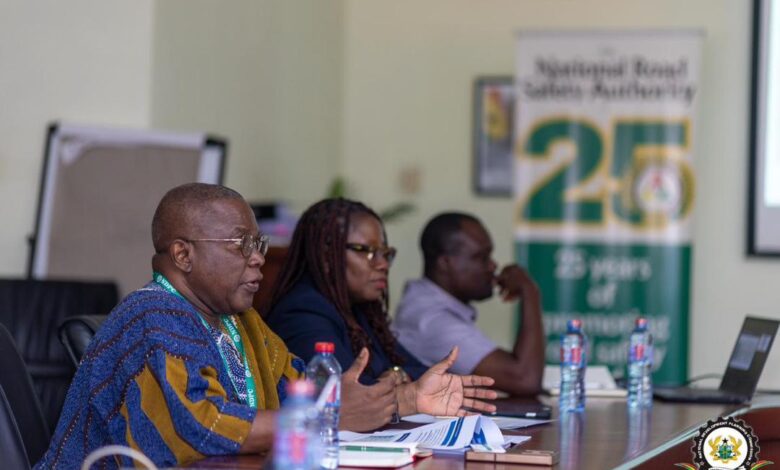
The National Development Planning Commission (NDPC) has engaged the National Road Safety Authority (NRSA) to identify key road-safety challenges, priorities and interventions to inform the preparation of the Strategic National Development Plan.
The engagement, held on Thursday, 27 August 2026, formed part of the Commission’s consultations with key institutions to identify development challenges that should be addressed through the Strategic National Development Plan. Discussions focused on persistent road indiscipline, enforcement, institutional capacity, road-crash data, behavioural change and inter-agency coordination, as well as measures to improve road-safety outcomes.
Opening the engagement, Chairman of the NDPC, Dr. Nii Moi Thompson, said road safety must be viewed within the broader context of national development, stressing that weak enforcement and disregard for regulations have consequences for public safety, productivity and the returns on public investments.
He observed that Ghana’s challenge was not necessarily the absence of laws or institutions, but the ability of those institutions to translate their mandates into measurable results.
“What is the conveyor belt at this Authority? Is it broken? If it’s broken, why is it broken? How can we fix it?” he asked, underscoring the need to identify and address institutional bottlenecks that impede effective delivery.
Dr. Thompson also emphasised that institutional effectiveness must be accompanied by behavioural change, noting that laws and regulations alone could not produce the desired outcomes without compliance by citizens and institutions.
“The institutions and behavioural change have to go hand in hand,” he said, adding that sustainable development could not be achieved in an environment where disregard for laws and regulations was tolerated.
He further stressed that road-crash victims should not be viewed merely as statistics, as every life lost or seriously injured has implications for families, communities and the wider economy. He said concerns emerging from the engagement would inform the Commission’s work on governance, law and order, and effective institutions under the Strategic National Development Plan.
Responding, the NRSA’s Director of Monitoring and Evaluation, Mr. Alexander Ayeta, outlined the Authority’s interventions across education, enforcement, engineering and emergency response.
He said the Authority was pursuing technology-based approaches to enforcement, including the piloting of automated traffic enforcement systems. He also highlighted ongoing efforts to improve the availability and reliability of road-crash data to support planning, enforcement and decision-making.
Mr. Ayeta, however, identified inadequate funding and operational logistics as major constraints affecting the Authority’s ability to effectively deliver on its mandate.
In her remarks, the Director-General of the NDPC, Dr. Audrey Smock Amoah, said the Commission would explore areas of technical support, particularly in strengthening coordination, data collection and reporting on road safety at the sub-national level, including across the 261 Metropolitan, Municipal and District Assemblies (MMDAs).
She also proposed the incorporation of appropriate road-safety indicators into existing local government performance frameworks to strengthen monitoring and accountability and provide a clearer basis for assessing road-safety outcomes at the local level.
Senior officials of the NRSA also highlighted the need to strengthen decentralised road-safety structures, improve road design and pedestrian infrastructure, secure sustainable financing for emergency care for crash victims, and enhance coordination among institutions responsible for road safety.
They stressed that improving road-safety outcomes would require sustained collaboration among the NRSA, the Ghana Police Service, road agencies, health institutions, MMDAs and other relevant stakeholders.
The issues and proposals emerging from the engagement will inform the Commission’s ongoing consultations towards the preparation of the Strategic National Development Plan.