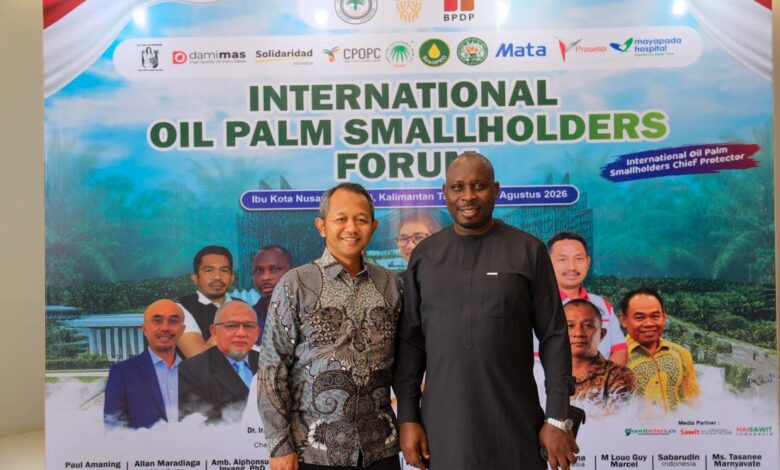
President of the Oil Palm Development Association of Ghana (OPDAG), Paul Amaning, made the call at the International Oil Palm Smallholders Forum in Ibu Kota Nusantara (IKN), East Kalimantan, Indonesia, where he highlighted Ghana’s experience with Fresh Fruit Bunch (FFB) pricing and the challenges confronting smallholder farmers.
Amaning said the future of the global oil palm industry must be measured not only by production volumes, exports and processing capacity, but also by the ability of farmers to earn fair and sustainable livelihoods from the crop.
“Oil palm is not simply a commodity,” Amaning told participants.
For millions of families, he said, oil palm provides income, employment, food security and rural development, linking farmers in rural communities to mills, processors, traders and international markets.
But that connection also exposes farmers to market volatility and uncertainty over how the value of their produce is determined.
Amaning stressed that every tonne of palm oil represents the work and investment of a farmer who planted the crop, waited years for the trees to mature and depends on the resulting income to support a household.
He argued that a successful oil palm sector should therefore not be judged solely by how much palm oil a country produces.
Instead, the industry should also be assessed by whether farmers can achieve sustainable incomes and reinvest in their farms.
“This is why transparent and predictable pricing is so important,” he said.
The Tree Crops Development Authority (TCDA), established under the Tree Crops Development Authority Act, 2019 (Act 1010), is responsible for regulating, developing and promoting designated tree crop subsectors, including oil palm.
Under the Tree Crops Regulations, 2023 (L.I. 2471), Ghana has established a framework for determining a Minimum Producer Price for Fresh Fruit Bunches.
Amaning emphasised that the minimum producer price is a price floor, rather than a single fixed price that applies to every transaction.
Actual prices may vary according to factors including quality, location, logistics, contractual arrangements and prevailing market conditions.
He said the distinction is important because the objective should be to protect farmers from unfair pricing while ensuring that processors remain commercially viable.
“The objective should not be to create conflict between farmers and processors,” he said. “The objective should be to create a fair and sustainable value chain in which both farmers and processors can survive and prosper.”
According to Amaning, Ghana’s pricing framework recognises the connection between the value of Fresh Fruit Bunches and the economics of palm oil products.
The statutory formula takes into account factors including the value of crude palm oil and palm kernel oil, while making deductions for processing costs, margins, aggregation costs, the TCDA levy and transportation costs.
The producer price is calculated and announced monthly.
Amaning said the approach demonstrates that smallholder farmers cannot be isolated from international markets, but neither should they be left completely exposed to global market fluctuations.
International palm oil prices, exchange rates, processing costs, transport costs and product quality can all affect the value of farmers’ produce.
But, he stressed, transparency is equally important.
Farmers need to understand how the price they receive is calculated so they can plan production, make investment decisions and negotiate more effectively.
A transparent producer-pricing mechanism, Amaning said, can make farmer incomes more predictable while improving bargaining power and strengthening coordination across the oil palm value chain.
It can also help processors plan raw-material costs and improve investment confidence.
However, he cautioned that legislation alone cannot deliver these outcomes.
Effective implementation requires reliable market information, accurate weighing and measurement, timely communication of official producer prices and strong monitoring and enforcement.
“In today’s digital age, information about producer prices should reach farmers quickly, clearly and directly,” he said.
Global oil palm markets are exposed to fluctuations in international prices, while exchange-rate movements can affect the local-currency value of internationally referenced commodities.
Farmers and buyers may also face disputes arising from differences in quality assessment and measurement.
Weak information systems can further disadvantage farmers who do not know the prevailing official price for their produce.
Amaning said the industry must simultaneously protect farmers’ interests and ensure the commercial sustainability of processors.
“Farmers must receive fair returns. Consumers must be protected from unnecessary cost increases. Government must create an enabling regulatory environment,” he said.
“These interests must not be treated as competing objectives. They are interconnected parts of the same value chain.”
When legitimate locally produced products compete with smuggled or informal products, he said, the consequences extend beyond farmers and processors.
Government can lose revenue, while legitimate investment can be discouraged.
He called for coordinated policies that protect legitimate producers and processors while maintaining an efficient and competitive market.
The answer, he argued, is not simply more regulation, but smart regulation, effective enforcement, transparency and collaboration.
Amaning urged financial institutions to recognise that oil palm is a long-term agricultural investment.
New plantations require years before they generate meaningful returns, making conventional short-term agricultural lending unsuitable for many smallholders.
He called for patient and affordable financing products designed around the biological and economic realities of oil palm production.
Such financing, he said, would enable farmers to establish plantations, maintain existing farms and invest in productivity improvements.
He encouraged smallholders to adopt better farm-management practices, improve harvesting techniques, strengthen producer organisations and build collective bargaining capacity.
He stressed that the future of oil palm should not depend primarily on expanding cultivated land.
Instead, the industry should focus increasingly on producing more from existing farms through better planting materials, improved management, reduced post-harvest losses, technology, extension services and access to finance.
“A productive farmer is a more profitable farmer,” he said.
“And a productive, profitable smallholder sector creates a stronger rural economy.”
Amaning called on processors and other industry players to deepen their relationships with farmers.
He urged the industry to reduce avoidable processing costs, establish transparent contractual arrangements and invest in quality, traceability and sustainable supply chains.
Such measures, he said, would help build trust across the value chain while strengthening the competitiveness of Ghana’s oil palm industry.
The OPDAG President used the international forum to call for stronger cooperation among oil palm smallholder organisations across producing countries.
While countries such as Ghana, Indonesia, Malaysia, Nigeria and Côte d’Ivoire face different circumstances, he said they share common challenges involving productivity, producer prices, access to finance, sustainability and market access.