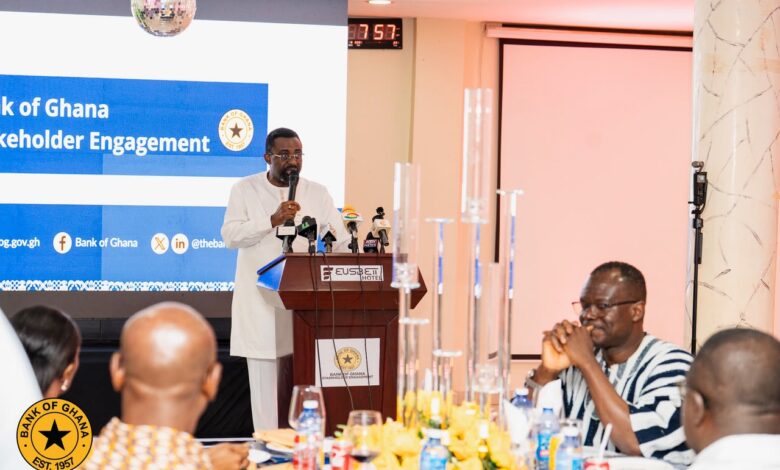
Governor of the Bank of Ghana, Dr. Johnson Pandit Asiama, has assured businesses in the Bono Region that the central bank remains committed to policies that will keep inflation low, stabilize the cedi and support private sector growth.
Speaking at a stakeholder engagement at the Eusbett Hotel in Sunyani on Tuesday evening, Dr. Asiama said meetings with business associations, bankers, traders and community lenders are key to shaping policies that respond to real challenges on the ground.
“Meetings like this are very important because they give us the opportunity to listen to one another,” he told representatives of AGI, GUTA, GNCCI, the Association of Bankers, Community Banks, Forex Bureaus and the media.
“One of my priorities since assuming office has been to make the work of the Bank more open and transparent.”
“One of my priorities since assuming office has been to make the work of the Bank more open and transparent.”
MPC Maintains Policy Rate at 14%
Updating the gathering on recent monetary policy decisions, Dr. Asiama said the Monetary Policy Committee last month decided to hold the policy rate at 14.0 percent.
The decision, he explained, was aimed at balancing inflation control with support for businesses and investment, while keeping flexibility to respond to global shocks, including rising oil prices due to tensions in the Middle East.
Inflation “Low and Under Control
“On inflation, the Governor said the slight uptick from 3.7 percent in May to 5.3 percent in June was driven mainly by higher transport costs following the rise in crude oil prices.
“We believe this is temporary, and we will continue to monitor developments closely to ensure that inflation remains under control,” he said.
He noted that keeping inflation low helps households manage budgets and gives businesses confidence to invest.
He noted that keeping inflation low helps households manage budgets and gives businesses confidence to invest.
Economy Growing at 6.4%
Dr. Asiama reported that Ghana’s economy grew by 6.4 percent in the first quarter of 2026, up from 6.2 percent in the same period last year. Growth was driven largely by services and industry.
He added that business and consumer confidence is improving, lending rates have fallen, and there is increased activity in trade, industrial production and tourism.
Banking Sector Strong, Credit Up 41%
The banking sector, he said, remains “well-capitalised” with growing deposits and improved loan quality.
“Most importantly, banks are lending more to the private sector. Credit to businesses and households grew by more than 41 percent in June this year, compared with about 9 percent a year earlier,” he stated.
Cedi Stable, Reserves at $12.9bn
On the external sector, Dr. Asiama said strong exports of gold and cocoa helped Ghana record a higher trade surplus in the first half of the year.
Ghana’s gross foreign reserves now stand at about US$12.9 billion, enough to cover five months of imports. The cedi, which came under pressure earlier in the year, has since recovered.
“We remain committed to maintaining an orderly and well-functioning foreign exchange market,” he added.
“Stability Is A Partnership”
Looking ahead, the Governor cautioned against complacency given global uncertainties, but said BoG will continue to prioritize cedi stability, low inflation and financial sector soundness.
“Macroeconomic stability is not the responsibility of the Bank of Ghana alone – it is a partnership between policymakers, businesses, financial institutions, traders, farmers, and households,” he said.
He ended by expressing optimism that the discussions in Sunyani will strengthen efforts to drive growth in the Bono Region and across Ghana.
The stakeholder engagement forms part of the Bank of Ghana’s renewed drive to deepen dialogue with regional business communities and financial sector players.