‘History asks us to inherit responsibility, not guilt’- Mahama on reparatory justice
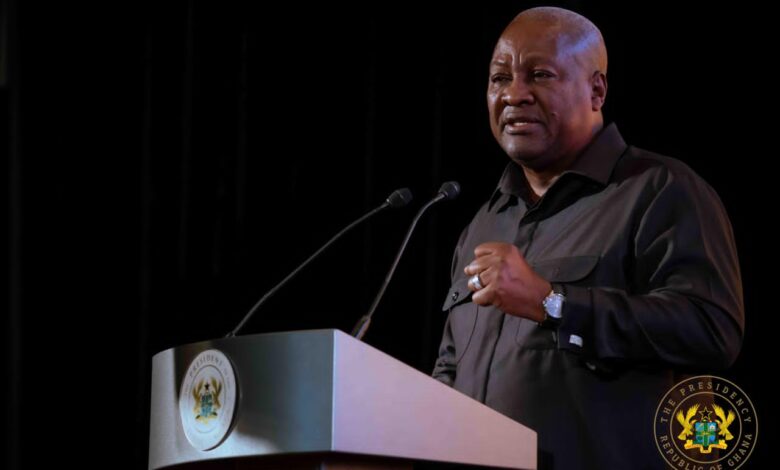
President John Dramani Mahama has called on the international community to confront the enduring consequences of the transatlantic slave trade with honesty and collective responsibility, insisting that the pursuit of reparatory justice is about addressing historical injustices rather than assigning blame to present generations.
Speaking at the High-Level Consultative Conference on the Next Steps to the Landmark United Nations Resolution on the Trafficking of Enslaved Africans in Accra, Mahama said no one alive today can be held personally responsible for the atrocities committed during the transatlantic slave trade, but every generation has a duty to address the legacy those crimes have left behind.
“None of us gathered in this hall today can be held personally responsible for the atrocities of the transatlantic slave trade and racialised chattel enslavement of Africans,” he said.
“We did not build the ships that crossed the Atlantic, we did not provide the insurance for loss of human cargo at sea, we did not upgrade the castles and plantations, we did not create the legal systems that transformed human beings into property or denied them their most basic human rights.”
Mahama stressed that while the crimes belong to another era, their consequences continue to shape modern societies.
“History does not ask us to inherit guilt, but it asks us to inherit responsibility,” he said. “While we may not bear responsibility for actions committed centuries ago, we are responsible for the world those actions have helped to create.”
He explained that today’s generation has inherited institutions, inequalities and structures shaped by slavery and colonialism, making it imperative to work towards justice, reconciliation and sustainable development.
“The question is therefore not whether we are guilty of the past, but whether we are prepared to address its enduring consequences. That is the test facing our generation,” the President added.
Mahama urged governments, international organisations, faith communities, scholars and civil society groups to work together to advance reparatory justice through dialogue rather than division.
He welcomed growing efforts by religious institutions and governments to acknowledge their historical links to slavery, citing recent engagements by Pope Leo XIV, the Church of Scotland, the Church of England, and French President Emmanuel Macron as encouraging signs of progress.
According to the President, meaningful reparatory justice must go beyond acknowledging history and focus on expanding opportunities, promoting human development and creating a more equitable future for communities affected by the lasting consequences of slavery.
He also reaffirmed his support for the African Union’s decision to establish an African-Caribbean Joint Mechanism on Reparative Justice, describing it as an important step towards strengthening cooperation between Africa and the diaspora.
Mahama said the Accra conference should serve as a platform for developing a practical international roadmap centred on truth-telling, education, memorialisation, restitution of cultural heritage, legal pathways and stronger partnerships.