Mahama unveils 3 global panels to advance reparatory justice
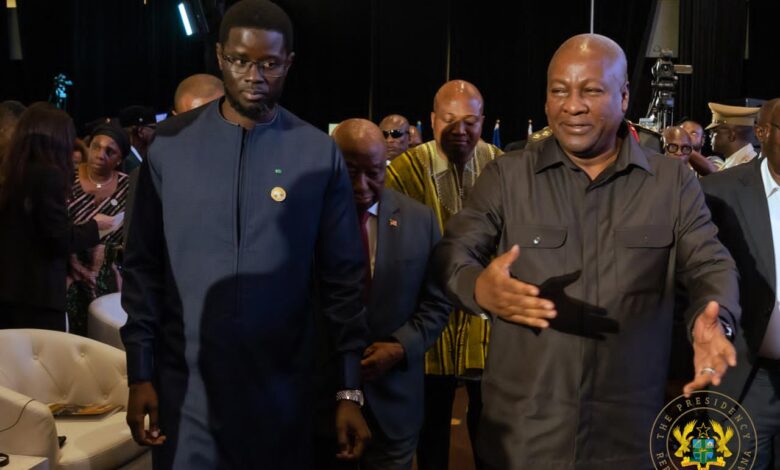
President John Dramani Mahama has announced the establishment of three global panels to drive the implementation of the landmark United Nations General Assembly Resolution on the Trafficking of Enslaved Africans, describing the move as a crucial step from international recognition to concrete action on reparatory justice.
Speaking at the High-Level Consultative Conference on the Next Steps to the Landmark United Nations Resolution on the Trafficking of Enslaved Africans in Accra, Mahama stressed that the goal is not to reopen old wounds but to promote healing, justice, understanding and reconciliation grounded in truth.
“We do not seek to reopen old wounds; we seek to heal those wounds. We do not seek division; we seek justice and understanding and reconciliation grounded in the truth,” he said.
Mahama said the conference marked the beginning of a practical process aimed at addressing the enduring consequences of the transatlantic slave trade and ensuring that the UN resolution translates into meaningful international action.
To sustain the momentum, he announced three key initiatives: a Global Advisory Panel on Reparatory Justice, made up of heads of state, eminent leaders and public figures to provide strategic guidance; an Expert Panel on the Restitution of Cultural Artefacts, to support the return of cultural properties, archives, sacred objects and historical treasures to their rightful owners; and a Global Legal Panel on Reparatory Justice, bringing together distinguished jurists and legal scholars to explore legal pathways consistent with international law and human dignity.
President Mahama explained that the panels would complement, rather than replace, the work of governments, regional organisations and international institutions by providing technical, intellectual and policy support. He also endorsed the CARICOM 10-Point Plan as an important foundation for their work.
As African Union Champion on Reparations, Mahama reaffirmed his support for the African Union’s decision to establish an African-Caribbean Joint Mechanism on Reparative Justice, arguing that the transcontinental nature of slavery requires a similarly broad international response.
“The crime we seek to address was transcontinental in its reach. Its consequences remain transcontinental in its impact, and the search for justice must therefore be transcontinental in its ambition,” he stated.
The President underscored that today’s generation should not inherit guilt for historical atrocities but should accept responsibility for addressing the inequalities and institutions created by that history.
“History does not ask us to inherit guilt, but it asks us to inherit responsibility. The question is not whether we are guilty of the past, but whether we are prepared to address its enduring consequences,” he said.
Mahama also called for greater global cooperation, welcoming recent acknowledgements by religious institutions, including Pope Leo XIV, the Church of Scotland and the Church of England, as well as renewed engagement by world leaders such as French President Emmanuel Macron.
He further emphasised that reparatory justice must be gender-responsive, recognising the unique suffering endured by enslaved African women and girls and honouring the contributions of women who have led the struggle for justice across generations.
The President said the conference aims to develop a practical international roadmap focused on truth-telling, education, memorialisation, restitution of cultural heritage, legal action and stronger partnerships between Africa, the diaspora and the wider international community.