Amnesty International: Global Executions at 44-Year High, Urges Ghana to Fully Abolish Death Penalty
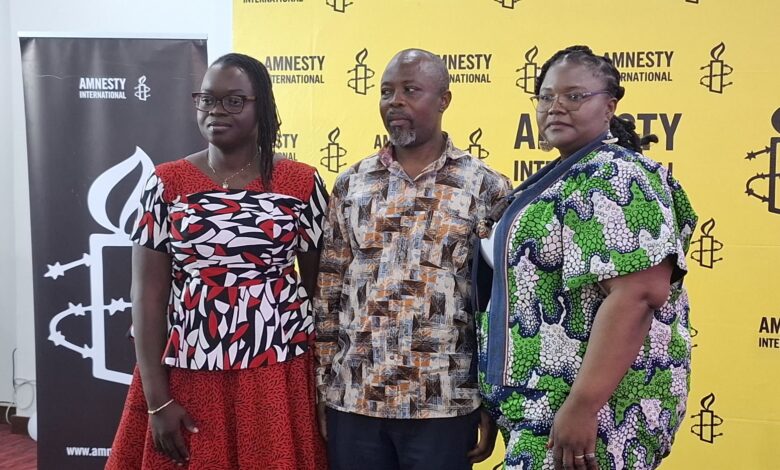
Global executions reached their highest level since 1981 in 2025, with at least 2,707 people put to death worldwide, Amnesty International revealed at the launch of its 2025 death penalty report in Accra on Monday.
Speaking at the event, Hannah Osei, Acting Director of Amnesty International Ghana, said the figure represents only the minimum confirmed total, with the true number likely far higher due to secrecy in several states.
“The death penalty remains one of the gravest violations of the right to life and human dignity,” Osei told attendees. “We are seeing a dangerous resurgence in the use of executions as a political tool of impunity.”
Iran and Saudi Arabia drive global spike
Iran alone accounted for 2,159 executions—nearly 80% of all recorded executions globally. Amnesty said many followed grossly unfair trials, including cases linked to the “Women, Life, Freedom” protests, and involved torture-tainted confessions and secret proceedings.
Saudi Arabia recorded its highest number of executions ever documented by the organization, with at least 356 people executed, many for drug-related offenses and broadly defined terrorism charges. In the United States, executions rose to their highest level since 2009.
Africa sees fewer executions but more death sentences
Across Sub-Saharan Africa, executions were recorded in only two countries: Somalia and South Sudan. Osei called this “an important and encouraging signal” that most African states refrained from carrying out executions.
However, death sentences surged across the continent. At least 771 death sentences were recorded in 2025, up 74% from 443 in 2024. The increase was driven largely by conflict, insecurity, political instability, and expanded use of military courts in countries such as the Democratic Republic of Congo and Sudan.
Osei flagged worrying legislative moves in Burkina Faso and Chad to reinstate or expand the death penalty for offenses like terrorism and espionage. In Nigeria and The Gambia, proposals emerged to broaden capital punishment to include drug trafficking and corruption-related crimes.
Zimbabwe was highlighted as a positive example after removing the death penalty for murder, treason, and offenses against the state and commuting all existing death sentences.
Ghana urged to complete abolition
Ghana was singled out as a regional leader on human rights and democratic governance. The country has not carried out an execution in over three decades and is considered “abolitionist in practice.”
Parliament removed the death penalty from the Criminal Offences Act and Armed Forces Act for ordinary crimes in 2022. But about 91 people remain under death sentence, and the punishment still exists in law for offenses like treason.
“Ghana has a historic opportunity to join the growing community of abolitionist states in Africa and around the world by fully abolishing the death penalty,” Osei said. “As long as it remains in our laws, the risk of its future use remains.”
Francis Nyantakyi, Board Chair of Amnesty International Ghana, said constitutional reform is the next and most critical step. He argued that life imprisonment is a safer alternative to avoid irreversible miscarriages of justice.
“Life once lost can never be reversed,” Nyantakyi said. “If new evidence comes and shows that person is innocent, then the person can have their life and freedom back.”
He noted that Ghana has recorded cases where people sentenced to prison were later exonerated, with some receiving state compensation. “If they have been killed, nothing could be done to bring them back,” he said.
Nyantakyi added that about 90% of people sentenced to death in Ghana who appealed with adequate legal support were later exonerated, according to records from lawyers and the Judicial Service. He also rejected the claim that the death penalty deters crime or coups.
“If the death penalty was a deterrent, thousands of people that have been killed, there wouldn’t be crime in our country,” he said.
“Behind every number is a human story”
Opening the launch, Charity Batuure, Board Vice Chair of Amnesty International Ghana, said the report is ultimately about people, not statistics.
“Behind every number is a human story, rights violated, communities impacted and families affected, who have lived for years in fear and waiting for a resolution,” Batuure said.
She described the death penalty as “the ultimate cruel, inhuman and degrading punishment” that disproportionately affects marginalized communities and vulnerable defendants who lack competent legal counsel.
Despite rising executions in some countries, Batuure said the global trend toward abolition is growing stronger, driven by activists, survivors, and citizens who believe in the value of every human life.
“Our goal in releasing this report is straightforward: to catalyze public and policy momentum for abolition,” she said. “The call is for all of us to take action now, do what is right for humanity, and also for future generations to come.”
Amnesty International reiterated its call for a total abolition of capital punishment in all cases, without exception, saying justice must be rooted in humanity, dignity, and human rights.