“Tricycles are not ambulances ” — Mahama clarifies use of vehicles under “Free Primary Healthcare” programme
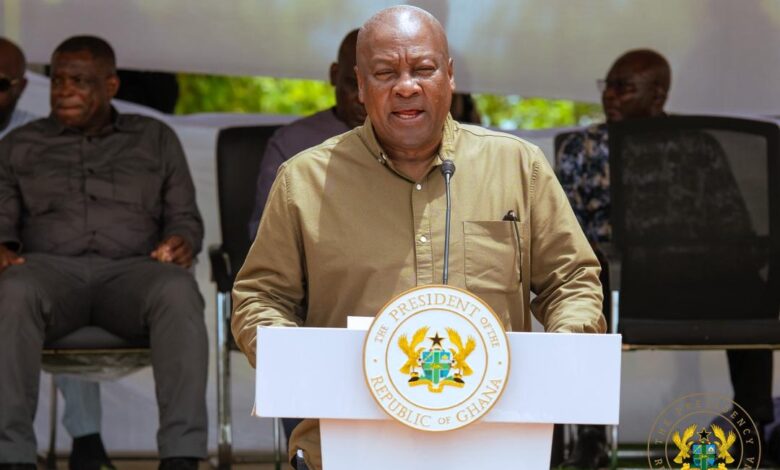
President John Dramani Mahama has clarified that tricycles distributed under the newly launched Free Primary Health Care Programme are not intended to serve as ambulances, but rather as mobility support for frontline health workers.
Speaking during the official Sod-cutting ceremony for the construction of 24-hour model economy market in Bimbilla, after the rollout of the Free Primary Healthcare initiative in Dodowa, the President explained that the vehicles are specifically designed to help Community-based Health Planning and Services (CHPS) personnel carry out outreach services in rural and hard-to-reach communities.
“In a related matter, two days ago in Dodowa, I inaugurated the beginning of the free primary health care programme… we handed over equipment and some vehicles to the CHPS compounds,” he said, noting that over 6,000 CHPS compounds across the country are expected to benefit.
Addressing public misconceptions, President Mahama stressed: “Let me be clear… those tricycles are not ambulances. Those tricycles are meant for the health workers and the health volunteers to go from village to village for screening.”
He explained that the tricycles are equipped with compartments to safely store vaccines, enabling health workers to maintain cold chain requirements while delivering immunisation services.
The President further highlighted regional considerations in the distribution of the vehicles. In northern Ghana, where many health workers are able to ride motorcycles, CHPS compounds will be provided with motorbikes. However, in southern parts of the country where riding motorcycles may be less common among health workers, tricycles will be deployed as a practical alternative.
President Mahama said the vehicles will enhance preventive healthcare delivery, allowing health workers to conduct screenings for conditions such as hypertension and diabetes, as well as administer vaccines at the community level.
He urged the public to avoid misinterpretations and misinformation about the programme, reiterating: “Those tricycles… are not ambulances. They are vehicles for the health workers… to go to the village, deliver vaccinations, and do health screening.”