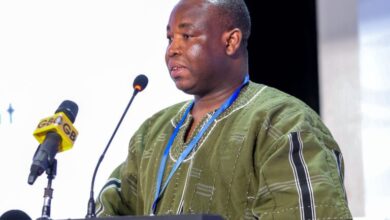
Petition To Mahama: Samson Awingobit Wants Sentuo Airport Garden City Project Halted Over National Security Concerns

A private citizen, Samson Asaki Awingobit, has petitioned President John Dramani Mahama to immediately suspend construction works on the US$1.3 billion Sentuo Airport Garden City Project over what he describes as grave national security implications.
In a detailed petition addressed to the President at the Jubilee House, Mr. Awingobit said while he welcomes foreign direct investment and is not opposed to Chinese investment in Ghana, the strategic location of the project at 10 Giffard Road, Airport Residential Area in Accra, demands a second look beyond ordinary planning and commercial considerations.
The Sentuo Airport Garden City Project, being developed by the Sentuo Group, had its ceremonial sod-cutting performed by President Mahama on September 15, 2026.
According to publicly announced plans, the project will comprise approximately 582 premium apartments, a 600-room hotel, a 2,500-capacity conference facility, healthcare facilities, a shopping mall, landscaped gardens, parking facilities and other commercial and leisure amenities.
Mr. Awingobit argues that the scale, height and nature of the development makes it fundamentally different from an ordinary residential or commercial property.
Strategic Location And Security Risks
In the petition, a copy of which has been seen by Graphic Online, the petitioner notes that Giffard Road is directly associated with Ghana’s military-security landscape, running from the 37 Military Hospital across the El-Wak area, Burma Camp and towards the eastern part of Accra, with documentation identifying Burma Camp and Air Force Base areas along the corridor as military zones.
“Ghana’s defence and national-security installations are strategic national assets. The Government must therefore carefully consider whether the proposed development, once completed, could provide direct or indirect visual, technological or physical access advantages over sensitive government and military facilities,” the petition states.
He raises concerns that high-rise buildings provide elevated vantage points over surrounding areas, while modern residential and commercial developments contain extensive telecommunications infrastructure, surveillance cameras, access-control systems, data networks, security-control rooms and other technological systems.
He is therefore asking whether the Ghana Armed Forces, the Ministry of Defence, the National Security architecture, the Ghana Police Service, the Ghana Civil Aviation Authority and other relevant agencies have conducted a comprehensive security assessment and formally certified that its location, design, height and operational model pose no unacceptable risk.
“If such an assessment has been conducted, the Ghanaian public deserves confidence that the appropriate security authorities have considered these matters. If it has not been conducted, it should be undertaken before construction proceeds beyond the point at which meaningful changes to the project would become difficult or prohibitively expensive,” he said.
Who Controls Security Infrastructure?
Mr. Awingobit further wants clarity on who will control the central security and surveillance systems of the complex when completed.
He lists critical questions that must be answered, including who will have access to security-control rooms, who will operate CCTV monitoring infrastructure, where surveillance data will be stored, who will have administrative access, what categories of foreign nationals will have access to restricted areas, what cybersecurity protocols will govern the development and whether Ghanaian security agencies will have statutory oversight.
“These are not questions directed at any particular nationality. They are questions that should arise whenever a major private development is situated close to strategic national assets,” he emphasized.
He also pointed to the project’s proximity to Kotoka International Airport, warning that if an individual using a property within the development were subsequently identified as posing a national-security threat, the proximity to Ghana’s principal international airport could potentially become a factor in the individual’s ability to leave the country rapidly.
Lessons From Dubai And Cambodia
To buttress his point, Mr. Awingobit cited international experiences where legitimate-looking real-estate assets have become associated with sophisticated criminal networks.
He referenced an investigation by the Organized Crime and Corruption Reporting Project (OCCRP) in Dubai which found that three Chinese nationals connected to a Singapore money-laundering case had acquired at least 22 Dubai properties worth approximately US$28 million, and that Chinese national Daren Li, sentenced in the US for his role in a cryptocurrency investment conspiracy involving over US$73 million laundering, owned a villa in Dubai.
He also cited Cambodia, where in May 2026, authorities raided two buildings at Phnom Penh’s Prince Plaza Centre linked to Chinese businessman Chen Zhi and detained 104 people, including 82 Chinese nationals, amid allegations of online-scam activity, seizing hundreds of mobile phones and computers. He noted similar raids at Ying Huang Casino where 925 computers were seized, and at Phnom Penh Galaxy Garden complex where 218 foreign nationals were detained over alleged technology-based fraud.
“These examples should not be interpreted as evidence against Chinese investment generally. Rather, they demonstrate the importance of robust due diligence, beneficial-ownership checks, tenant screening, cybersecurity controls, law-enforcement access and continuous security oversight,” he said.
10-Point Request
Mr. Awingobit is therefore making 10 requests to the President, including immediate suspension of construction pending a comprehensive national-security assessment, an independent multi-agency assessment involving the Ministry of Defence, Ghana Armed Forces, National Security, Police, GCAA, Ghana Airports Company Limited, a strategic land-use review, a counter-surveillance assessment, establishment of clear security-control arrangements, enhanced beneficial-ownership and source-of-funds due diligence, review of tenancy vetting mechanisms, consideration of design modifications, retention of oversight by Ghanaian security agencies, and making findings available to Parliament.
In his conclusion, he stressed that his petition is not anti-China or anti-investment.
“This petition is not anti-China. It is not anti-investment. It is not an objection to foreign direct investment… Ghana welcomes responsible foreign investment and needs investment to create jobs… However, economic development must never be pursued at the expense of national security,” he stated.
He added: “I am not asking the Government to reject investment. I am appealing to the Government to ensure that no investment, however substantial, compromises the security of the Republic of Ghana.”