President Mahama commissions phase III of ‘Zonda Tech’ assembly plant, targets automotive hub for West Africa
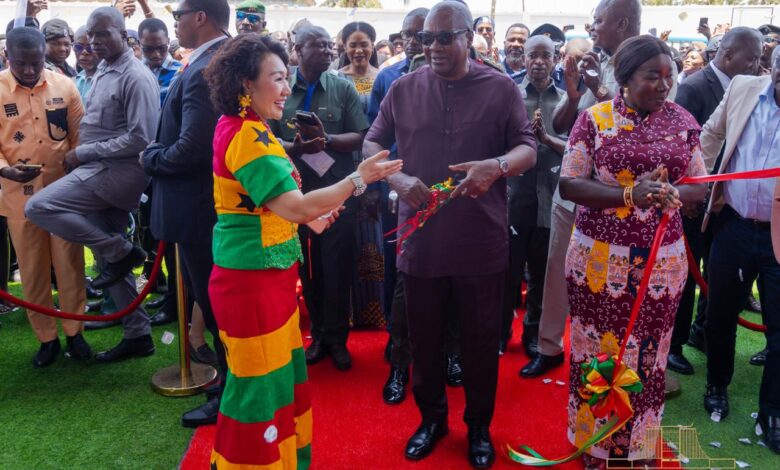
President John Dramani Mahama has commissioned Phase III of the Zonda Tec Ghana Limited vehicle assembly plant in Tema, reaffirming his government’s ambition to position Ghana as the automotive manufacturing hub of West Africa.
The expanded facility is expected to significantly increase Zonda Tec’s production capacity and nearly double direct employment at the company, while creating about 1,000 additional indirect jobs across logistics, maintenance, component supply, distribution and other supporting industries.
Speaking at the commissioning ceremony, President Mahama said Ghana’s automotive development agenda was deliberate, strategic and achievable, stressing that the country must move beyond vehicle assembly towards building an integrated automotive manufacturing industry.
“Our ambition to make Ghana the automotive manufacturing hub of West Africa is deliberate, strategic and achievable,” he said.
He noted that the Ghana Automotive Development Policy had already attracted globally recognised brands, including BMW, Toyota, Nissan, Hyundai, Honda, Kia, Great Wall Motors, Geely, Chery, Forland and Peugeot, while also creating opportunities for indigenous manufacturers such as Kantanka.
However, President Mahama said vehicle assembly could not be Ghana’s final destination.
“Assembling, however, cannot be our final destination. Our goal is to develop an integrated automotive industry in which locally produced materials and components feed directly into vehicle manufacturing,” he stated.
The President said the next phase of Ghana’s industrial strategy would focus on deepening value addition through the local manufacture of automotive components, including batteries, tyres, wiring harnesses, seats, glass, plastics and metal parts.
He said this would create stronger linkages between large manufacturers and Ghanaian small and medium-sized enterprises, retain more value within the domestic economy and generate additional employment opportunities.
President Mahama therefore urged Zonda Tec to identify opportunities to invest in the local production of some vehicle components.
The President also said Ghana was positioning itself to become a leader in electric mobility, leveraging its strategic mineral resources, including lithium, as well as its growing renewable energy capacity.
According to him, the country has the potential to develop an integrated battery and electric vehicle value chain to serve both domestic and continental markets.
“Our vision is clear: from minerals to batteries, from batteries to vehicles, from vehicles to exports—all proudly made in Ghana,” President Mahama said.
He disclosed that the Ministry of Energy and Green Transition was preparing an electric vehicle policy, particularly to regulate the establishment of EV charging stations across the country.
He explained that the policy was necessary to prevent an uncoordinated expansion of charging infrastructure that could place excessive pressure on electricity transformers and substations in particular areas.
The government, he added, would also encourage the use of solar energy for EV charging.
“We shall establish clear, transparent regulations so that those interested in going into EV charging stations can see a clear roadmap for doing so,” he said.
President Mahama further announced that the Ministries of Finance and Trade, Agribusiness and Industry were finalising discussions on incentives for semi-knocked-down automotive assembly.
He said government would introduce a minimum threshold for the level of local assembly that manufacturers must achieve before qualifying for VAT exemptions.
The measure, he explained, was aimed at ensuring that companies undertake meaningful assembly activities in Ghana rather than merely importing almost fully built vehicles and carrying out minimal work locally.
“A certain percentage of assembling must take place locally for you to qualify for the VAT exemption,” he said.
He indicated that details of the incentive would be announced by the Finance Minister in the next Budget to Parliament.
President Mahama also called for collaboration between government, vehicle manufacturers and the banking sector to develop long-term financing arrangements that would enable more Ghanaians to purchase locally assembled vehicles.
He said many public and private sector employees, including doctors, teachers, nurses and other workers, could afford new vehicles if they had access to suitable credit facilities that allowed them to make payments over time.
“Government is ready to collaborate with the private sector. We are ready to collaborate with the manufacturers. We are ready to sit down with them and come out with financing instruments,” he said.
He said such arrangements would allow income earners to acquire vehicles of their choice and repay the cost through monthly instalments over an agreed period.
President Mahama said the Zonda Tec expansion aligned with the government’s broader industrialisation agenda and the 24-hour economy programme.
He explained that the programme sought to promote continuous production by modern factories, increase productivity, expand exports and create more employment opportunities, particularly for young people.
“The 24-hour economy is not merely a slogan; it is taking shape factory by factory, factory floor by factory floor,” he said.
The President said vehicles produced at the expanded plant would support agriculture by moving produce from farms to markets, while also serving the mining, construction and transport sectors and facilitating regional trade.