President Mahama challenges SOEs to turn GH¢19.8bn profit into lasting gains
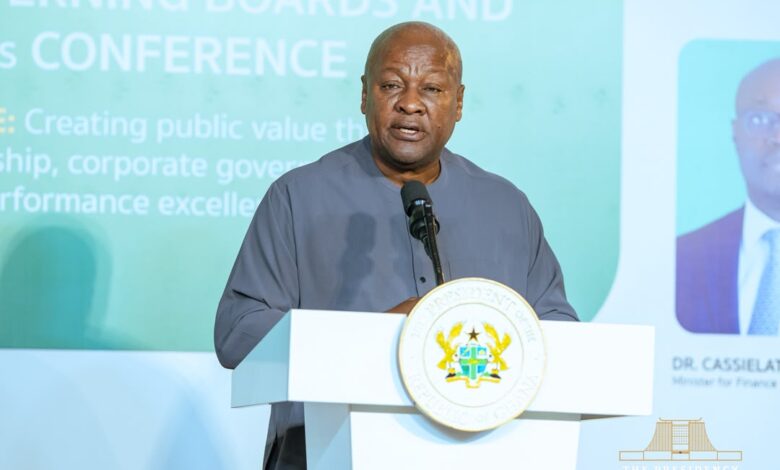
President John Dramani Mahama has commended state-owned enterprises (SOEs) for their significant financial turnaround in 2025, but has cautioned managements to sustain the gains through improved operational efficiency, stronger governance and better performance.
The combined performance of SOEs improved from an aggregate net loss of GH¢2.26 billion in 2024 to a net profit of GH¢19.8 billion in 2025.
President Mahama made the remarks at the 2026 State Interests and Governance Authority (SIGA) Governing Boards and CEOs’ Conference.
He said aggregate revenue generated by SOEs also increased from GH¢137.71 billion in 2024 to GH¢176.43 billion in 2025, representing growth of about 28.12 percent.
According to him, return on assets improved from 1.3 percent to 6.31 percent, while return on equity rose from negative 1.6 percent to 15.7 percent.
President Mahama, however, cautioned against interpreting the improved figures without considering the broader economic factors that contributed to the performance.
He noted that approximately GH¢11.72 billion in net foreign exchange gains, together with a 42.5 percent reduction in aggregate finance costs, had contributed significantly to the improved results.
“These are all encouraging figures, but they must be understood in context,” President Mahama said.
He challenged boards and chief executives to use the favourable financial conditions as an opportunity to strengthen the underlying performance of their institutions rather than rely on exchange-rate movements or temporary improvements in the business environment.
“A one-year turnaround is encouraging, but sustained performance is the real test,” he stated.
President Mahama commended 10 SOEs that recorded positive net profits in every year between 2021 and 2025.
The Ghana National Petroleum Corporation (GNPC) recorded the highest average annual profit among the entities at approximately GH¢2.25 billion, followed by the Ghana Ports and Harbours Authority (GPHA) with an average of GH¢1.41 billion and the Minerals Income Investment Fund (MIIF) with GH¢773.9 million.
He also recognised BOST Energies, which recorded an average annual profit of about GH¢348.1 million, alongside the Volta River Authority, Ghana Exim Bank, Ghana National Gas Company, TDC Company Limited, Ghana Supply Company Limited and the Venture Capital Trust Fund for their consistent profitability.
The President said the five-year consistency of these entities deserved recognition but also imposed an obligation on their boards and managements to strengthen governance and deliver greater value to the state.
He cited a number of significant turnarounds recorded in 2025, including the Tema Oil Refinery (TOR), which moved from a net loss of approximately GH¢745 million to a net profit of GH¢1.09 billion—its first net profit in almost a decade.
The Ghana Water Company Limited also moved from a loss of GH¢3.06 billion to a profit of approximately GH¢6.35 million, while the Ghana Cocoa Board (COCOBOD) moved from a loss of GH¢5.73 billion to a profit of GH¢5.11 billion.
BOST Energies increased its net profit from approximately GH¢3.98 million to GH¢6.84 million, while the GoldBod recorded a net profit of approximately GH¢896.5 million, compared with GH¢178.5 million in 2024.
President Mahama said the GoldBod results demonstrated the strategic importance of transparent, accountable and nationally beneficial structures for Ghana’s gold trade.
Despite the improvements, the President warned that significant weaknesses remained within the SOE portfolio.
He disclosed that five SOEs recorded losses in every year between 2021 and 2025, while other state entities recorded an aggregate deficit of approximately GH¢10.48 billion in 2025, up from GH¢2.40 billion in 2024.
He further noted that the average aggregate liabilities of those entities exceeded their net assets, highlighting the need for urgent reforms.
“We must therefore move decisively from isolated successes to system-wide improvement,” President Mahama said.
He directed that the next State Ownership Report must demonstrate measurable improvements in audited accounts, operational efficiency, profitability, dividend payments, service quality and corporate governance across all specified entities.
President Mahama also reminded boards and chief executives that the assets entrusted to them belong to the people of Ghana and are managed by public officials only in trust for the public.
“Public ownership must produce public value,” he stressed.
He said every institution represented at the conference must be able to demonstrate, with credible evidence, the value it has created for Ghanaians.
According to the President, the state did not establish enterprises merely to maintain offices, pay salaries and sustain institutions indefinitely, but because certain activities are strategic to national development, serve the public interest or address gaps that the market alone cannot resolve.
For commercial entities, he said the obligation was to remain efficient, competitive and financially sustainable while generating an appropriate return on investment.