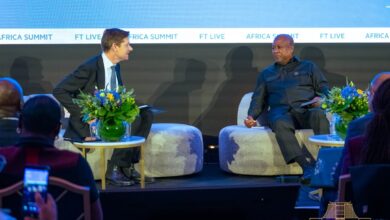
No more salary increases for chronically loss-making state enterprises-President Mahama
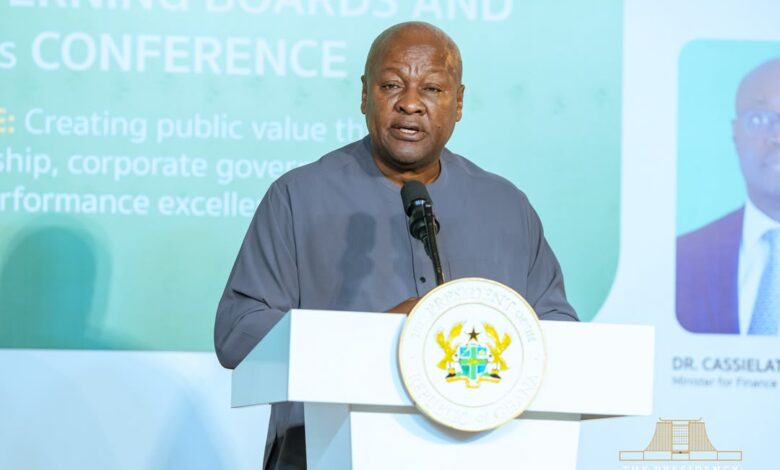
President John Dramani Mahama has warned that chronically loss-making state-owned enterprises (SOEs) cannot continue to enjoy systematic increases in salaries and allowances while failing to deliver value to the Ghanaian people.
He said government was committed to strengthening the relationship between remuneration, performance, productivity and institutional results, particularly within state-owned enterprises and other specified entities.
President Mahama made the remarks at the SIGA Governing Boards and CEOs’ Conference 2026, where he called for a fundamental shift in how compensation for executives of state institutions is determined.
“It is not fair to your shareholders to have salaries and allowances systematically increased, even in chronically loss-making enterprises,” he said.
According to the President, compensation, particularly at the executive level, could no longer be determined independently of an institution’s performance.
He said government intended to progressively establish a system where remuneration reflected an enterprise’s financial health, productivity, achievement of agreed targets, quality of service, fiscal sustainability and the broader value created for the state and the Ghanaian people.
President Mahama stressed that the objective was not merely to control salaries but to create appropriate incentives for performance, strengthen accountability and ensure value for money.
“High-performing public enterprises and their leaders should be appropriately recognized, but poor performance cannot be continually rewarded without consequences,” he stated.
He therefore directed board chairpersons, chief executives, managing directors and management teams of SOEs and other specified entities to cooperate fully with the State Interests and Governance Authority (SIGA) and the Fair Wages and Salaries Commission as the government transitions towards the proposed Independent Public Emoluments Commission.
The President said such cooperation must include the timely submission of accurate information on compensation, conditions of service, financial performance and other relevant institutional data.
He also called for full participation in benchmarking and compensation reviews, as well as strict compliance with approved remuneration frameworks and government directives.
“No state-owned enterprise must maintain a compensation arrangement outside the established national framework merely because of its corporate status or revenue-generating capacity,” President Mahama said.
He cautioned that institutional autonomy must not become a justification for unjustified disparities, opaque compensation practices or remuneration that bears no relationship to performance.
President Mahama consequently tasked SIGA, the Fair Wages and Salaries Commission, the Ministry of Finance, sector ministries, boards and chief executives of SOEs to work together to develop a harmonised framework linking corporate performance, executive accountability and compensation.
“Our objective must be clear: every cedi the state invests in compensation must ultimately contribute to productivity, stronger institutional performance and measurable public value,” he said.
The President further emphasised that state-owned enterprises were established to serve strategic national interests and generate economic and social value, rather than simply maintain offices, pay salaries and sustain institutions indefinitely.
He warned that commercial SOEs must become efficient, competitive and financially sustainable, while entities with public service mandates must demonstrate measurable social and economic value to citizens.
President Mahama also reminded state enterprises that the national budget could no longer serve as a permanent cushion for poorly managed institutions.
“Every cedi transferred, guaranteed, or written off on behalf of a poorly managed enterprise limits what the government can invest in classrooms, in clinics, in roads, jobs, and social protection,” he said.
He urged boards and management to increase revenues, control costs, manage debts, protect cash flows and address structural inefficiencies before they become fiscal risks.
The President also directed profitable SOEs to meet their dividend obligations, stressing that returns on public investments ultimately belong to the people of Ghana.