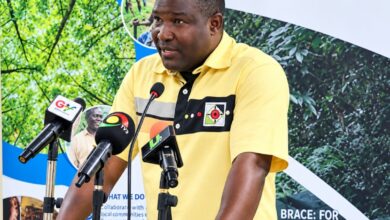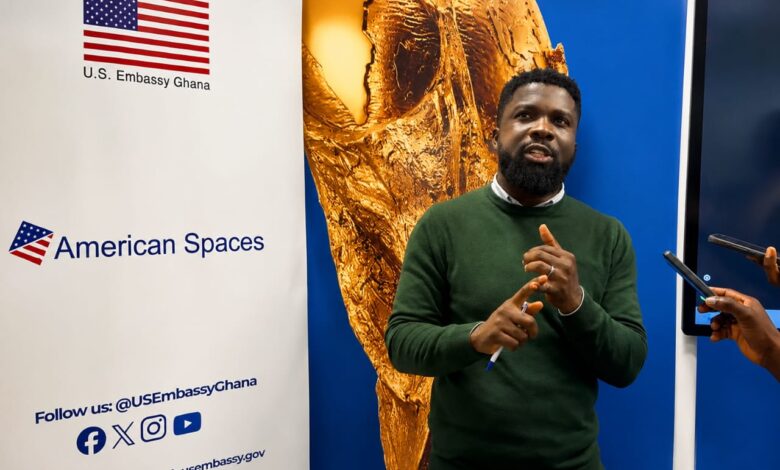
Digital transformation strategist Cherubim Mawuli Amenyedor has charged Ghanaians to stop limiting Artificial Intelligence to just “models and apps” and instead view it as a 5-layer ecosystem that begins with energy, if the country hopes to tap into the projected $30 billion AI opportunity for Sub-Saharan Africa by 2030.
He was speaking at “Freedom250: Leveraging U.S. A.I Technologies for Business Success: An Exchange Alumni Perspective” organized by the US Embassy Ghana, Accra on Wednesday.
“AI Is More Than ChatGPT”
The Chevening Scholar and Mandela Washington Fellow urged participants to see AI holistically.
“I also charge participants to see AI from the holistic point of view. AI as a five-layer case begins from the very level of energy, then to chips, then to infrastructure, before the models and the apps,” he said.
“Most often than not, our trainings or our interactions with AI limit ourselves only to the models and then the apps. We need to rethink how we use AI, especially in our Ghanaian context. We need to be also asking questions around the governance of AI tools, AI platforms, AI models, even beyond the infrastructure, the chips, and even at the energy level.”
He referenced a 2024 Google report which projected that AI could add up to $30 billion to the Sub-Saharan Africa economy by 2030.
“The charge of my thinking is this: How could we, as a country, how could we as entrepreneurs, professionals, or even as a civilization, how much of the 30 billion do you want to take?” he asked.
“Mind you, as the 30 billion is projected to come in, it’s also going to take some jobs. So it’s also about rescaling yourself, retooling yourself, making yourself relevant in today’s AI age.”
*From Basic Prompting To “Advanced Prompting”*
The session moved participants from beginner to advanced levels of using AI tools, with focus on responsible use.
“I also took them to some basic to advanced level prompting, learning how to talk to machines to get the right feedback or the right answers that you want from a machine in a very, very step by step form. They went from very basic prompting all the way to what I’ve called a bit of advanced prompting.”
He emphasized that users should not accept AI outputs blindly. “I also charge our participants to use AI more responsibly. You don’t just put something in and take everything it says: hook, line, sinker.”
The training focused on credible U.S. tools like ChatGPT by OpenAI and Google’s Gemini, but also exposed participants to other platforms.
A key takeaway, he said, was learning about MCPs – using AI inside already established professional software.
“If let’s say you’re an architect, how can you use ChatGPT or Cloud tool or an MCP to do your work in Revit, to do your work in 3D Max, to do your work if you’re a designer in Canva… Learning already how to talk to machines and learning to use this software in those machines can unlock a level of productivity that we’ve never seen before.”
“We are a shift. There’s a shift towards the use of AI, which is going to get into a leap soon, and those who seize these opportunities at the shift stage would be those who make the most from the AI era.”
Policy Recommendation: Start With Education
From a policy perspective, Mr. Amenyedor said education must be the “kickstarter” for Ghana’s AI readiness.
“I would start with education because it’s something I’m necessarily passionate about. I think that we need to really educate for a future that uses AI. As best as it stands now, we are just mostly most of our education is around ‘chew and pour’, as we call it. We memorize knowledge, but we should go beyond learning how to maximize or make the most use of knowledge.”
“We should be preparing children, our kids, our students for a world that will be AI first, and it requires a new level of thinking, a new level of preparation. I’m always for using AI in the classroom.”
He noted he is less worried about the workplace adapting, because “supply will always go where demand is.” But for children to compete globally, “the Ghanaian kids should be able to play well in that area as well.”
He also taught participants about tokenization to help them avoid wasting money on AI tools, and how to know which tool to use for which problem.
For Journalists: “Set A Thief To Catch A Thief”
Responding to a question on how mainstream journalists can stand out amid free speech and a flood of online content, Mr. Amenyedor said AI itself is the best weapon against misinformation.
“I think there’s an old saying that you set a thief to catch a thief, and in our world where there’s so much misinformation, disinformation, and malinformation, AI in itself positions best to be able to get us to understand.”
His first charge to journalists: invest in literacy. “First of all, journalists should also invest in high-level literacy. So as journalists, every journalist should be equipped with basic misinformation, disinformation, malinformation tools to be able to fact-check things at the speed of light. Because the onslaught of the perpetrators is at an alarming speed.”
He recommended three areas for journalists:
1. Local context tools: He cited “Vox” by Nigerian techie Celestine, a tool adapted for West African languages. “When people see certain Akan words, Ga words, Ewe words online, some broad level AI may not be able to get a context for what he’s saying. So he has a tool… Vox Speak, Vox Sentiment. Is able to play our local videos… He’s created a model for our West African specific context. I’ve used it for a lot of clients I have as well.”
2. Media monitoring tools: Such as Brand24 and PR listening tools.
3. Free tools: “Even sometimes the free one, Google. I know there’s a free Google tool for listening. Yeah, so I think you can use that to just stay on top of things.”
He added that platforms are now labeling AI-generated content, which journalists must also learn to detect and disclose.
About The Speaker
Cherubim Mawuli Amenyedor is Managing Director of STRIMPE, a digital strategy and transformation consultancy. He has 12+ years experience working with brands including Twitter Ghana, GCB Ghana, StarTimes, Infinix Ghana, and Budweiser.
He is a 2020 Chevening Scholar, 2023 Mandela Washington Fellow, and 2024 British Council Alumni UK Ambassador for Sub-Saharan Africa. He won the 2017 Ghana Social Entrepreneurship Competition with the “Ho Node Hub” project and served as a 2018 UNDP Ghana SDG Ambassador.
He holds master’s degrees in Marketing Strategy from the University of Ghana and Digital Marketing from Robert Gordon University, UK. He is currently a PhD researcher exploring AI adoption and marketing strategy within West Africa.