Reparatory justice must move from recognition to action- President Mahama
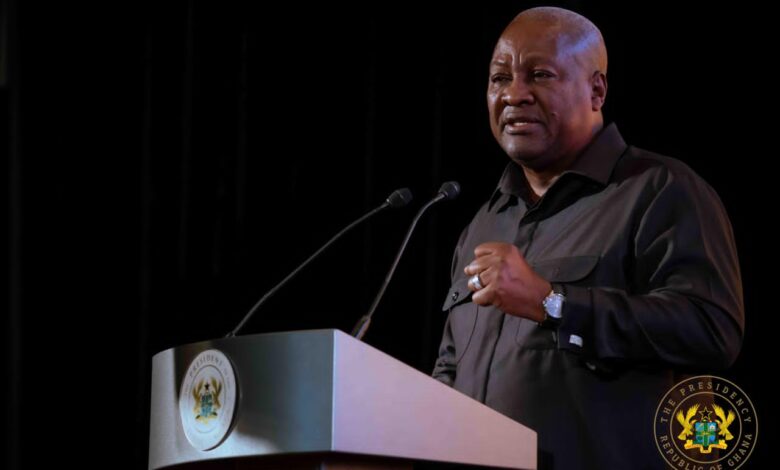
President John Dramani Mahama has called on the international community to move beyond acknowledging the historical injustices of the transatlantic slave trade and take concrete steps towards achieving reparatory justice.
Speaking at the High-Level Consultative Conference on the Next Steps to the Landmark United Nations Resolution on the Trafficking of Enslaved Africans in Accra, Mahama said the adoption of the landmark United Nations General Assembly resolution was only the beginning of a broader process aimed at addressing the enduring consequences of slavery.
“The adoption of the resolution was never intended to mark the end of the journey. It was intended to provide the foundation for a more meaningful process of engagement, reflection and action,” he said.
He stressed that the conference was convened to answer the critical question of what comes next, noting that international recognition creates a responsibility to pursue sustained and coordinated action.
“We are here because recognition creates responsibility and because the enduring consequences of this history continue to demand thoughtful, coordinated and sustained international engagement,” the President stated.
Mahama said reparatory justice should be forward-looking and focused on creating opportunities for communities still affected by the legacy of slavery.
“Reparatory justice is not only about acknowledging the past. It is also about expanding opportunity, advancing human development and creating a more just future for communities affected by the enduring consequences of this historical injustice,” he said.
To translate the UN resolution into practical outcomes, Mahama announced the establishment of three global panels to guide the next phase of the international reparations agenda.
The first, a Global Advisory Panel on Reparatory Justice, will comprise heads of state, government leaders and eminent public figures to provide strategic direction for international dialogue and cooperation. The second, an Expert Panel on the Restitution of Cultural Artefacts, will support efforts to return cultural property, archives, sacred objects and historical treasures to their countries and communities of origin. The third, a Global Legal Panel on Reparatory Justice, will bring together jurists and legal scholars to explore legal pathways consistent with international law and human dignity.
According to Mahama, the panels are intended to complement the work of governments, regional organisations and international institutions by providing technical, intellectual and policy support.
He also endorsed the CARICOM 10-Point Plan for Reparatory Justice as an important starting point for the work of the newly established panels.
The President reaffirmed his support for the African Union’s decision to establish an African-Caribbean Joint Mechanism on Reparative Justice, saying the transcontinental nature of the slave trade requires an equally broad and coordinated international response.
Mahama urged governments, international organisations, academic institutions, civil society groups, faith communities and the African diaspora to work together in developing a practical roadmap that promotes truth-telling, research, education, memorialisation, restitution of cultural heritage and legal action.
He concluded by reminding participants that the success of the reparatory justice movement would ultimately be measured by tangible progress rather than declarations.
“The UN General Assembly resolution marked an important moment of international recognition. The responsibility now is to ensure that this recognition translates into meaningful and sustained action,” he said. “Future generations will judge us not by the resolutions we adopted, but by the progress we achieved.”