Equip National Labour Commission To Work Effectively, Speakers Tell Government
Call comes as Commission marks 20th anniversary in Accra
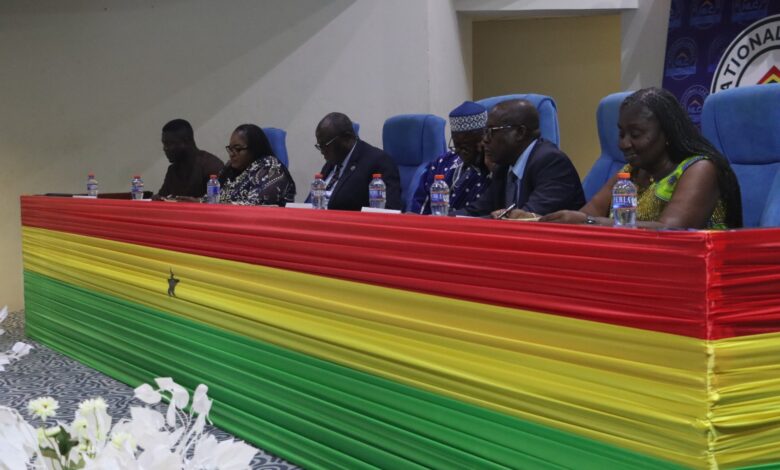
Speakers and resource persons at a symposium in Accra have unanimously urged government to adequately resource the National Labour Commission (NLC) to enable it to perform its duties effectively.
The call was made during a forum held at *Shippers House* to commemorate the 20th anniversary of the Commission.
“Lack of Tools and Funding Hindering Work”
The speakers said the Commission lacks working tools and financial capacity, which is affecting service delivery.
According to them, successive governments have not paid adequate attention to strengthening the Commission, making it difficult to meet its mandate.
They agreed that government must hire and motivate professionals for the day-to-day running of the Commission, with the right tools, remuneration and allowances to attract qualified staff. The current allowances, they noted, are “not good enough.”
The speakers also cited the lack of trained personnel, logistics, offices, better working conditions, regional and district offices, and modern equipment as major challenges.
They added that in today’s era of AI and evolving technology, the work of the Commission must be digitalized to improve efficiency and speed of case resolution.
As a result of these constraints, they said, many labour cases are delayed and settlement is slow.
Those who spoke included Mr. Ofosu Asamoah, former Executive Secretary of the Commission; Mr. Ansah, Secretary General of the Trades Union Congress (TUC); Dr. Bernice Welbeck, current Executive Secretary; and Mr. Seddoh, a Commissioner among others.
20 Years of Resolving Labour Disputes
Earlier, Dr. Bernice Welbeck, Executive Secretary of the NLC, gave an account of the law that established the Commission.
She explained that while various labour laws existed, Parliament consolidated them in 2003 and the Labour Act, 2003 (Act 651) gave meaning to the Commission in 2005.
She enumerated several achievements of the Commission, saying the industrial atmosphere would have been different without its intervention.
According to her, the Commission has handled many landmark cases involving wrongful dismissals, leave matters, maternity, casual workers, promotions, compensations, negotiations, mediations, arbitrations, settlements, strikes, and court actions — most of which were resolved through collaboration between disputing parties.
Dr. Welbeck, however, lamented the lack of interest and knowledge of labour laws among some workers, employers and even the TUC.
“Many workers don’t develop the interest of reading the labour laws to be abreast of the law and their welfare,” she said.
She called on all working groups to play by the rules to avoid unnecessary standoffs and unhealthy industrial confrontations.
She stressed that litigation is not the Commission’s preferred style. “We want a peaceful working environment to ensure productivity.”
The National Labour Commission was established to promote and maintain industrial harmony in Ghana.