Lands Minister Directs GGSA To Approve All Building Permits After GH₵28m Upgrade Of Earthquake Data Centers To Prevent Structural Collapses
Lands Minister says GH₵28m earthquake data upgrade must translate into mandatory seismic audits and dual approval from GGSA and Ministry of Works
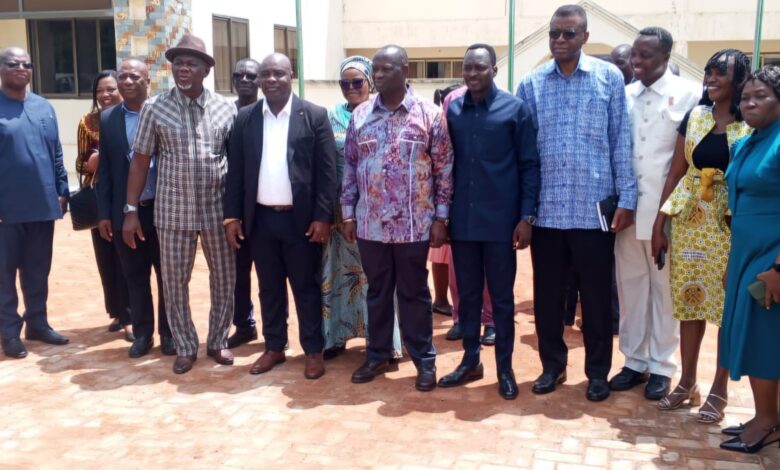
The Minister for Lands and Natural Resources, Hon. Emmanuel Armah-Kofi Buah, has directed the Ghana Geological Survey Authority (GGSA) to play a central role in approving building permits nationwide. The move, he says, is critical to ending Ghana’s recurring building collapses and strengthening seismic safety standards.
Speaking at an event to highlight government investment in disaster preparedness, Hon. Buah stressed that the days of leaving geological safety checks out of construction approvals must end. He revealed that government has invested GH₵28 million to upgrade and modernize Ghana’s earthquake monitoring data centers, bringing previously non-functional facilities back online.
From non-working to real-time monitoring
The Minister did not mince words about the state of the infrastructure before the upgrade. “All of them were not working. All of them needed upgrade one way or the other,” he stated firmly.
He recalled that the Mahama administration identified the decay of Ghana’s seismic data centers as a national security risk and committed the funds needed to revitalize them. With the upgrade complete, Hon. Buah said Ghanaians can now expect timely, accurate data. “Today the good news is that we are able to tell the people of Ghana that we will provide them with up-to-date data when there is any risk of earthquake, when there is any risk of tremor,” he assured.
He described the intervention as part of a broader “reset” of Ghana’s safety protocols, where science and data drive policy decisions.
Dual approval for building permits
The core of the Minister’s directive is regulatory change. Going forward, developers and builders will need approval not only from the Ministry of Works and Housing but also from the Ghana Geological Survey Authority before a building permit is issued.
Hon. Buah argued that most recent building collapses could have been avoided if the GGSA had conducted seismic audits before construction began. “If the Ghana Geological Survey is able to do this seismic audit, we wouldn’t be waking up to see buildings coming down,” he said.
The new requirement will put geological factors under the spotlight. GGSA will review foundation designs, assess soil stability, and certify earthquake resilience for new structures. For the mining sector, the authority will also enforce stricter compliance to prevent environmental and structural disasters.
“Nine to eight” regulations must improve
Referring to the current state of building and mining regulations, the Minister used the phrase “nine to eight” to describe a weak framework that needs urgent tightening. He charged the GGSA to rise to the challenge and enforce its mandate without compromise.
“Builders must obtain the necessary NC permits mandated by law not just from the Ministry of Works and Housing but prominently from the Ghana Geological Survey as well,” he directed. The aim, he added, is to ensure structures are designed with both safety and durability in mind from day one.
GH₵28m investment as a lifesaving backbone
Government is confident the upgraded data centers will serve as the backbone for real-time geological monitoring and early warning systems. The facilities are expected to detect tremors and other ground risks quickly, giving authorities and citizens critical time to respond.
Hon. Buah expressed appreciation to President Mahama’s administration for prioritizing the project, noting that public safety should never be compromised by outdated infrastructure.
What it means for Ghanaians
For ordinary Ghanaians, the directive means stricter checks before new houses, offices, and commercial buildings go up. While it may add one more step to the permit process, the Minister insists the trade-off is worth it if it prevents loss of life and property.
Engineers, architects, and developers will now have to factor seismic data into their designs earlier. District assemblies and planning authorities will also need to work closely with GGSA to ensure compliance.
In summary, Hon. Emmanuel Armah-Kofi Buah’s directive marks a pivotal shift: Ghana is moving from reactive disaster response to proactive prevention. With GH₵28 million invested and the GGSA now empowered at the permit stage, the government hopes to build a future where headlines about collapsed buildings become rare.
The Minister concluded by urging all stakeholders in the construction and mining sectors to cooperate fully with the new requirements, emphasizing that safety is a shared responsibility.