Health Workforce Key to Ghana’s UHC Agenda – VP Opoku-Agyemang as Gov’t Recruits 16,000 Workers in 2026
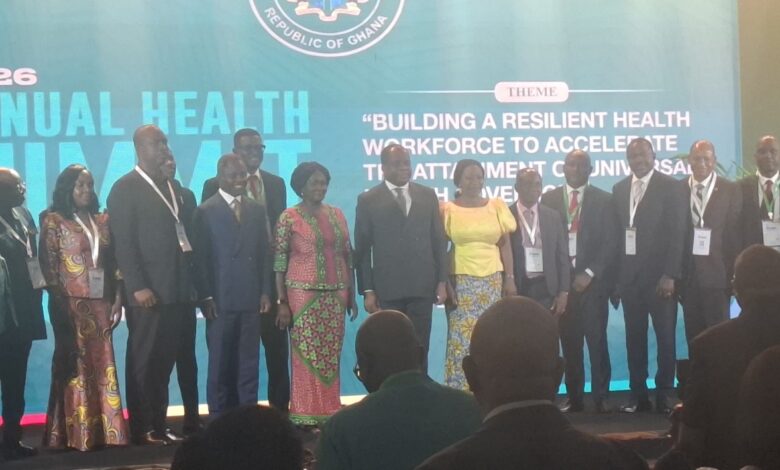
Vice President Professor Jane Naana Opoku-Agyemang has declared that a resilient and well-distributed health workforce is the foundation for achieving Universal Health Coverage and strengthening Ghana’s healthcare system.
Speaking at the opening of the Ministry of Health’s three-day Annual Health Summit in Accra, the Vice President said health must be viewed not just as a social service but as “an economic investment and a pillar of national security.”
The summit, themed “Building a Resilient Health Workforce to Accelerate the Attainment of Universal Health Coverage,” brought together policymakers, health professionals, development partners and industry stakeholders.
“Health Should No Longer Be Seen as Just Social Service”
Prof. Opoku-Agyemang said the recently launched Accra Reset on Health Sovereignty provides a framework for African countries to reduce dependency and strengthen domestic financing, local capacity, and workforce development.
She said Ghana is translating that vision into action through the Free Ghana Healthcare Initiative, the Ghana Medical Trust Fund popularly called Mahama Cares, and targeted investments in personnel.
“A strong health workforce is the foundation of a resilient health system and a prerequisite for achieving the aspirations of the Accra Reset. While Ghana has made significant progress in expanding its health workforce, disparities in distribution remain, with many underserved communities still facing shortages,” she stated.
16,000 Health Workers to be Recruited, 8,000 Already in Process
The Vice President revealed government granted financial clearance in 2026 for the recruitment of 16,000 health professionals, with 8,000 currently being recruited to strengthen primary healthcare delivery.
She said the exercise supports the government’s flagship free primary healthcare initiative, with community health nurses, midwives, physician assistants and public health officers identified as critical frontline workers.
The VP stressed that retention must be treated as a national development priority. “Professionals are more likely to remain in underserved communities when they have access to decent housing, reliable transportation, security and other essential social amenities. We must move beyond sectoral silos so that a rural posting is not regarded primarily as hardship,” she added.
On migration, she commended the Ministry of Health for pursuing managed migration agreements and exchange programmes to maximize benefits of global mobility while protecting Ghana’s system.
Health Minister Unveils Bold Reforms
Minister for Health, Kwabena Mintah Akandoh, outlined an ambitious reform agenda under the government’s _Resetting Ghana_ agenda, describing resilient health professionals as the cornerstone of UHC.
“The reforms we are implementing represent a deliberate shift from treatment to prevention, from fragmented interventions to integrated systems, from short-term fixes to long-term resilience, and from a system focused primarily on illness to one focused on wellbeing,” he said.
Key reforms and data he announced:
1. Coverage gains: NHIS active membership rose from 57% in 2021 to 66% in 2026. Out-of-pocket expenditure has declined significantly.
2. Workforce numbers: Ghanaians made nearly 39 million facility visits in 2025. Health workers supervised 780,000 deliveries and provided antenatal care to over 1 million expectant mothers. 1.8 million children under five received child welfare services.
3. Recruitment & deployment: Over 14,000 health workers were placed on payroll in 2025. An additional 16,000 will be recruited in 2026, with ∼8,000 already recruited. Doctors accepting postings to underserved regions jumped from 12 in 2024 to about 100 in 2026.
4. Training: Specialist training has been decentralised. A new perioperative nursing programme has enrolled 475 nurses this year, with plans for 1,000 annually. Scholarships for doctoral studies and the Ghana Labour Exchange Programme for skills exchange are also active.
5. Infrastructure: At least 10 Agenda 111 hospital projects will be operationalised this year, with about 35 facilities targeted for completion. Construction of three new regional hospitals in Savannah, Western North and Oti regions, plus three cardiac centres, will begin soon.
Mr. Akandoh acknowledged persistent inequity: while 41% of Ghanaians live in rural areas, only 38% of health workers serve there. Greater Accra and Ashanti still attract most doctors and pharmacists.
“Our challenge today is not simply training more health workers. It is employing them, deploying them equitably, motivating them, supporting them and retaining them,” he said.
The Bottom Line
Both leaders agreed: Universal Health Coverage will be delivered by people, not just buildings or policies.
“Universal health coverage will be achieved through people. Let us invest in them, support them and continue to build a system they are proud to serve in,” Prof. Opoku-Agyemang concluded.
“When health workers thrive, communities thrive. When communities thrive, economies grow. And when economies grow, nations prosper,” Minister Akandoh added.
The summit continues with technical sessions on specialist care, diagnostics, long-term care for chronic diseases, ethics, and practitioner wellness.