MEDREX 2026: Ghana and US Medical Teams Deepen Partnership Through Hands-On Collaboration at 37th Military Hospital
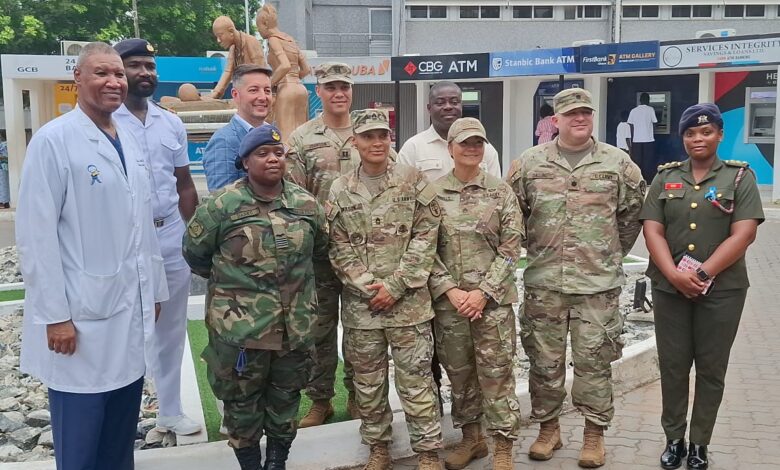
For three weeks, the halls of the 37th Military Hospital in Accra have been alive with a unique blend of Ghanaian and American accents, shared surgical procedures, and cross-cultural learning as the third iteration of the Medical Readiness Exercise (MEDREX) 2026 unfolds.
What began as a training initiative has evolved into a sustained partnership between the Ghanaian Armed Forces (GAF) medical team and US military medical personnel from Landstuhl Regional Medical Center, Dental Health Activity–Rheinland Pfalz, and the North Dakota National Guard. The exercise, planned and executed by the US Army Southern European Task Force, Africa (SETAF-AF), is designed to strengthen medical readiness for both countries in resource-limited and combat environments.
A Platform for Mutual Growth
“This is the one place where collaboration and partnership building meets readiness,” said *Colonel Claude Burnett*, Director of Global Health Engagement and an obstetrician-gynecologist at Landstuhl Regional Medical Center. “It’s where we can build relationships, deepen collaboration, exchange knowledge, and at the same time engage in direct, live patient care.”
For Col. Burnett, who is participating in his third MEDREX iteration, the progress is tangible. “Each time we come back, we see progress. Some things have been implemented. Of course, there are still challenges and goals, but it’s definitely rewarding to see that progress,” he said. Working in the hospital’s obstetrics and gynecology department, he described the Ghanaian staff as “extremely good to us, very accommodating. I almost feel like we’ve become family.”
That sentiment was echoed across the hospital. Master Sergeant Tatiana Mason, the Non-Commissioned Officer in Charge for MEDREX 2026, said this year’s integration has been smoother than before. “The relationship and the building of relationships with our Ghanaian counterparts has made the integration a lot smoother. We were welcomed with open arms,” she said. Leading a team of 25 US participants with specialties including biomedical and orthopedic surgery, Mason noted that the trauma cases seen at 37th Military Hospital provide US personnel with clinical experiences they rarely get at home.
Three Core Aims, One Shared Goal
*Commander Aggrey Orleans*, part of the MEDREX coordination team, outlined the exercise’s three core objectives: *operational readiness, interoperability, and mutual development*.
“The first aim is to ensure our medical corps can function in any environment — whether resource-restricted or fully equipped,” he said. “The second is interoperability, so that Ghanaian and US personnel can work seamlessly in the same theater. The third is mutual development through the exchange of best practices.”
Commander Orleans said this year’s exercise has achieved those aims to “a very large extent.” One of the biggest changes, he noted, is the speed of integration. “This year was faster. We built up from last year. We don’t have to start from zero anymore. Medicine is universal, but we all have different systems and practices, and now we’re getting closer to how we both operate.”
Beyond the clinical work, he emphasized the personal bonds formed. “The friendships we build now go beyond the particular exercise. I’m still in touch with people who were here five or even six years ago. These are enduring friendships.”
Hands-On Training Across Specialties
The exercise covers a wide range of medical fields. *Lieutenant Colonel David Dalling*, Officer in Charge of MEDREX 2026, said the collaboration spans dental, physiotherapy, and multiple clinical specialties. “It’s really a collaborative effort to learn from each other and share experiences and skills,” he said. “It’s an opportunity to have specific clinical experiences that are sometimes difficult to get in our environment, and at the same time share what we bring.”
In the dental department, *Lieutenant Colonel Shadrack Owusu*, a specialist orthodontist at 37th Military Hospital, said the exchange has been revealing. “We’ve had the privilege of discussing cases and treatment plans with our American counterparts. We realize what we are doing here is not any different from what they are doing there,” he said. The dental team routinely handles toothaches caused by dental caries, performing restorations with available materials. While he acknowledged a “technology gap,” he stressed that the current system has been effective with no patient comebacks.
On the surgical front, Major Ian Schroeder, an orthopedic surgeon at Landstuhl Regional Medical Center, has participated in 35 to 40 procedures during his three-week stay. “We’ve done quite a few external fixators for open fractures, intramedullary nailing for tibia and femur fractures, ankle fractures, distal radius fractures, and hip fractures,” he said. The variety mirrors what he would see at a US trauma center, but with one key difference: resource constraints.
“Sometimes the best implant isn’t available, so we have to improvise,” Major Schroeder explained. “That simulates a deployed environment where we have to make do with what we have. That’s what I’ve learned a lot from the surgeons here — how to think on the fly.”
Working alongside him is *Sergeant Michael Boakye*, an OR scrub tech also stationed at Landstuhl Regional Medical Center. “It’s very fascinating to work in a diverse environment and make sure we are medically ready for humanitarian and combat operations,” he said.
Local Voices, Lasting Impact
The Ghanaian staff have also found value in the partnership. *Freda Agyapong*, a nurse in the maternity theatre at 37th Military Hospital, said the US team quickly became part of the hospital family. “When they came in, they didn’t feel shy. It was always nice to work with them. We really appreciate them a lot,” she said. “They always follow instructions, and even when things are different, it’s always for the good.”
Beyond the Hospital: A Broader Partnership
The US Embassy in Accra views MEDREX as part of a broader cooperation framework. *Matthew Asada*, Press Attaché and Acting Public Affairs Officer at the US Embassy, said the exercise reflects the depth of US-Ghana security cooperation.
“We’re doing things like working together on humanitarian missions, providing airlift for the Ghanaian Engineering Regiment to Jamaica, and partnering on law enforcement to combat cybercrime,” he said. He also highlighted shared priorities around the 2026 FIFA World Cup, which the US will co-host with Canada and Mexico.
“Whether it’s security cooperation, law enforcement, immigration — all these things we’re doing together with our Ghanaian partners — knowledge sharing and knowledge transfer is at the heart of everything,” Asada said.
Looking Ahead
As MEDREX 2026 continues, participants from both countries agree that the exercise is no longer just a training event — it’s a sustained partnership that enhances medical readiness, builds trust, and creates lasting professional and personal ties.
For Mason, the experience feels personal. “For a lot of the participants, this was a great opportunity. For me, this was a welcome home.”