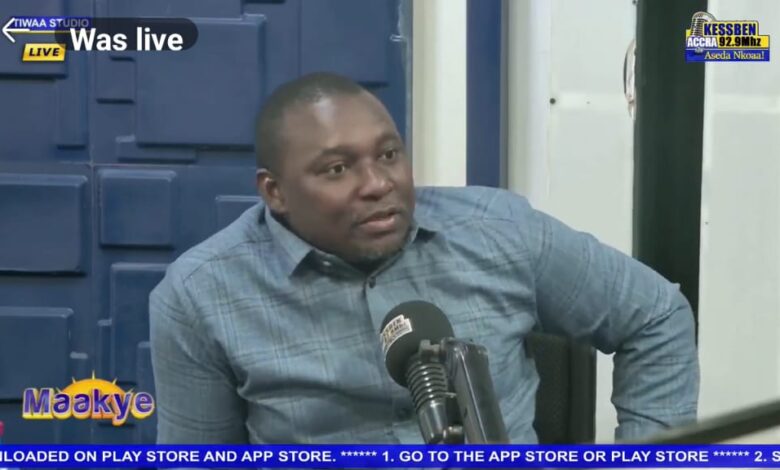
Director of Communications for the United Party (UP Plus), Solomon Owusu, has launched a sharp critique of the opposition New Patriotic Party (NPP), accusing the party of lacking the moral authority to comment on Ghana’s current power challenges.
Speaking on national issues surrounding the country’s energy sector at Kessben Maakye show, Mr. Owusu referenced Genesis 1:3, stating, “God said, let there be light, and there was light,” to emphasize the significance of stable electricity in national development.
According to him, the NPP has “woefully disappointed Ghanaians” and therefore lacks the credibility to speak on matters of power supply.
He argued that President John Dramani Mahama administration inherited Ghc 80 billion energy sector debt with 68 billion relating to ECG alone.
Mr. Owusu also addressed a recent call by Habib Iddrisu, Tolon MP, for the release of information under the Right to Information (RTI) law on the energy sector, noting that while requesting such information is a constitutional right, the relevant minister could indicate that the government is awaiting the Auditor-General’s report before proceeding. This he insisted the mid-year financial audit would be due in June so any figure given in ow would not be realistic till the due time.
He further alleged that the previous NPP administration failed to account for the COVID-19 levy and E-levy insisting that transparency remains a critical issue in governance.
In the energy sector, Mr. Owusu argued that Ghana’s challenges are rooted in longstanding structural problems rather than short-term failures. He claimed that transformers procured under the NPP administration were not installed because it was an election year and the government feared public backlash over potential power outages, commonly referred to as “dumsor.”
He stressed that the country’s development struggles are partly due to poor national planning, adding that institutions such as the Electricity Company of Ghana (ECG) and Town and Country Planning must work together more effectively.
“ECG and Town and Country Planning should collaborate in developing the nation,” he said, underscoring the need for coordinated infrastructure planning to support Ghana’s long-term growth.
Mr. Owusu’s remarks come amid ongoing public debate over the management of Ghana’s energy sector and the broader issue of accountability in governance.