Mahama calls for “Localised AI” to reflect Ghanaian realities and languages
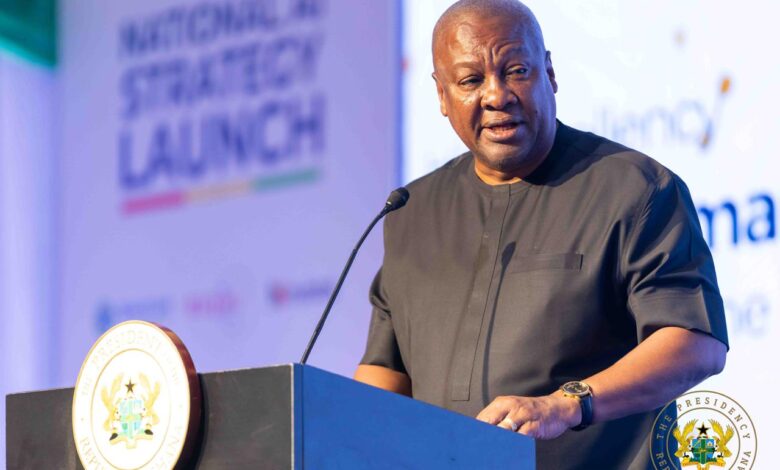
President John Dramani Mahama has urged a deliberate shift towards building artificial intelligence systems that reflect Ghana’s cultural context, languages, and lived realities, warning that dependence on foreign-trained models risks excluding large segments of the population.
According to him, at official launch of Ghana’s Artificial Intelligence programme, President Mahama said, most existing AI systems are shaped by “foreign culture, languages and assumptions,” making them less effective in addressing local needs and understanding indigenous contexts.
“Existing AI systems are trained on data shaped by foreign culture, languages and assumptions. As a result, they often fail to reflect our values, linguistic diversity and cultural context,” he said.
He stressed that Ghana must not simply adopt AI technologies but actively adapt and localise them to serve its people effectively.
“Ghana cannot build a meaningful AI future using systems that do not understand our Ghanaian realities. We must invest in local data ecosystems, promote the integration of our indigenous languages and support the development of context-aware AI systems that reflect who we are and serve the needs of our people,” he stated.
President Mahama illustrated his point with a personal anecdote about an AI application used in his household. He explained how the technology helped diagnose a struggling cactus plant, identifying overwatering as the problem and recommending a reduced watering schedule.
“My daughter used an AI app at home. My wife’s cactus was not thriving, so she pointed the app at it and it diagnosed that the plant was being given too much water and recommended watering it just once a week,” he recounted.
He noted that while the application provided accurate guidance, its usefulness depended heavily on language comprehension.
“With that same app, we can use it on our farms to identify diseases and improve agricultural practices. But my daughter could read English and understand the diagnosis. What about the rural farmer who cannot read or write English?”
He emphasized the need for AI systems that translate and interpret findings into local languages to ensure accessibility for all users, especially farmers in rural communities.
“We should be able to have a local language interpret what the AI has diagnosed so that the farmer understands the problem with his crop. In other words, we must not only use AI, we must localise AI,” he added.