Africa imports over 70% of medicines; President Mahama pushes local pharmaceutical production
President John Dramani Mahama has called for increased investment in pharmaceutical manufacturing across Africa, saying the continent’s heavy dependence on imported medicines is both a health challenge and a missed economic opportunity.
He said Africa currently imports more than 70 percent of its pharmaceuticals and nearly 99 percent of its vaccines, with tens of billions of dollars leaving African economies each year to pay for medicines and vaccines produced outside the continent.
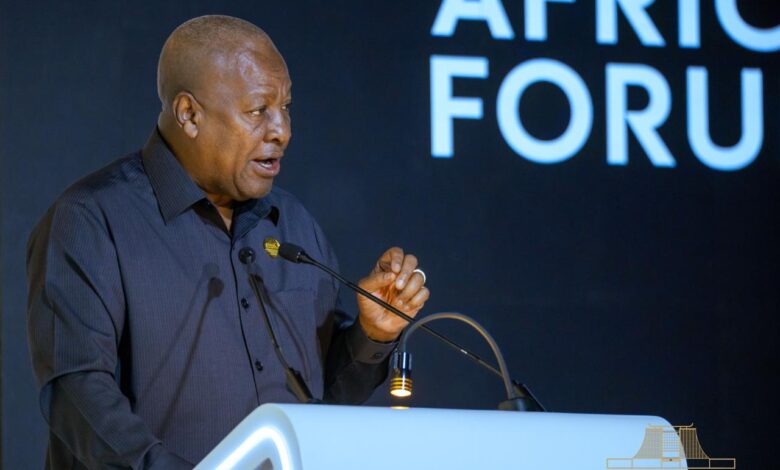
President Mahama made the call while delivering a keynote address at the Alamein Africa Forum in Egypt, held alongside the 8th African Union Mid-Year Coordination Summit.
According to him, Africa must begin to see healthcare not simply as a cost to governments but as an important sector capable of driving manufacturing, creating jobs and strengthening economies.
“Health is not a charitable cost; it is an investable, high-growth economic sector,” he said.
President Mahama said Africa’s growing population provides a strong market for companies willing to invest in local pharmaceutical production.
He noted that the continent’s population is projected to reach about 2.5 billion by 2050, creating rising demand for essential medicines, chronic disease treatment and biologic products.
He said the African Continental Free Trade Area (AfCFTA) also gives manufacturers an opportunity to produce for a continental market rather than being restricted to individual countries.
“African manufacturing does not serve a single country of 30 million people. It serves a single unified market of 1.4 billion consumers,” he said.
President Mahama also pointed to an Africa Centres for Disease Control and Prevention (Africa CDC) pooled tender for maternal and child health products as evidence of the potential of coordinated purchasing.
President Mahama said producing medicines locally would allow African countries to retain more of their foreign exchange and reduce their vulnerability to disruptions in global supply chains.
He also highlighted the employment potential of a stronger pharmaceutical industry.
Africa, he said, faces a shortage of about six million health workers, while nearly one million trained healthcare professionals and science graduates remain unemployed.
Local pharmaceutical manufacturing, he argued, could create opportunities in research and development, clinical trials, engineering, biotechnology and other specialised fields.
“This means high-value jobs in Africa,” he said.
President Mahama pointed to Egypt’s response to hepatitis C as an example of what African countries can achieve by combining public health interventions with domestic production.
He said Egypt negotiated technology transfers, built local production capacity and treated about four million people locally, helping it make significant progress towards eliminating hepatitis C.
He also cited Nigeria’s African Medical Centre of Excellence in Abuja, supported by Afreximbank and King’s College Hospital, as an example of efforts to keep specialised medical services on the continent.
“When we keep high-end specialised care on the continent, we retain skills, wealth and consumer confidence,” he said.
President Mahama said Ghana was also taking steps to reduce its dependence on imported health products.
He cited the expansion of the National Health Insurance Scheme, the introduction of Free Primary Healthcare, the establishment of the Ghana Medical Trust, and efforts to strengthen the Food and Drugs Authority and the National Vaccine Institute.
The goal, he said, is to help Ghana move from being largely a consumer of health products to becoming a producer.
President Mahama urged governments, private investors, commercial banks and industrial developers to work together to build pharmaceutical factories, strengthen supply chains and support health-sector innovators.
“Let us stop treating health as a line-item expense in our budget. Let us build the factories, integrate supply chains, fund innovators and secure our citizens’ future,” he said.
He said a stronger African pharmaceutical industry would not only improve access to essential medicines but also help create jobs, stimulate manufacturing and strengthen the continent’s economic resilience.