Africa’s 1.4bn population creates huge market for local drug manufacturing – President Mahama
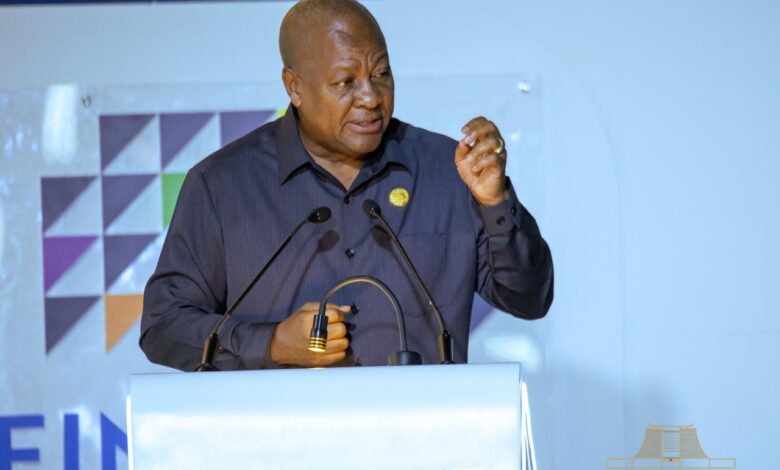
President John Dramani Mahama has called on investors and African businesses to take advantage of the continent’s growing population and rising demand for medicines by investing in local pharmaceutical manufacturing.
According to President Mahama, Africa’s population of about 1.4 billion people represents a huge and growing market for essential medicines, vaccines and other health products.
He said Africa’s increasing demand for medicines, particularly for chronic diseases and other long-term health needs, presents a significant opportunity for local industries to expand production and create jobs.
President Mahama made the call while delivering a keynote address at the Alamein Africa Forum in Egypt, held alongside the 8th African Union Mid-Year Coordination Summit.
He said Africa must move away from treating healthcare simply as a cost to governments and instead recognise the sector as an important area for economic investment.
“Health is not a charitable cost; it is an investable, high-growth economic sector,” President Mahama said.
He noted that Africa currently imports more than 70 percent of its pharmaceuticals and nearly 99 percent of its vaccines, resulting in billions of dollars leaving the continent each year to pay for medicines and vaccines produced elsewhere.
For him, building local manufacturing capacity would not only improve access to medicines but also help African countries conserve foreign exchange, protect their economies from global supply disruptions and create employment.
President Mahama said the African Continental Free Trade Area (AfCFTA) provides an added advantage because manufacturers would not be limited to individual national markets.
“African manufacturing does not serve a single country of 10 or 30 million people. It serves a single unified market of 1.4 billion consumers,” he said.
He pointed to a recent Africa Centres for Disease Control and Prevention (Africa CDC) pooled tender for maternal and child health products as evidence of what could be achieved when African countries combine their purchasing power.
According to him, aggregating demand across countries resulted in price reductions of more than 30 per cent, while African manufacturers secured 50 per cent of the product lines.
President Mahama said coordinated demand could give local manufacturers predictable markets and cash flows, making the pharmaceutical sector more attractive to banks, institutional investors and industrial players.
He also linked local pharmaceutical production to employment, particularly for Africa’s young population.
He cited a World Health Organisation estimate that Africa faces a shortage of about six million health workers, while nearly one million trained healthcare professionals and science graduates remain unemployed.
Local manufacturing, he said, could create opportunities in research and development, clinical trials, engineering and biotechnology, while helping retain skilled professionals on the continent.
President Mahama further cited Egypt’s experience in tackling hepatitis C as an example of how domestic pharmaceutical production and technology transfer could support major public health interventions.
He said Ghana was also taking steps to strengthen its health sector through the expansion of the National Health Insurance Scheme, the introduction of free primary healthcare, the establishment of the Ghana Medical Trust, and efforts to empower the Food and Drugs Authority and the National Vaccine Institute.
“These are the three questions we need to answer to bring governments and business together to assist in creating health sovereignty for Africa,” he said.
President Mahama urged African governments, commercial banks, sovereign funds and private investors to work together to build pharmaceutical factories, strengthen supply chains and support innovators.
“Let us stop treating health as a line-item expense in our budget. Let us build the factories, integrate supply chains, fund innovators and secure our citizens’ future,” he said.
He said the ultimate goal should be an Africa capable of producing more of the medicines and health products its people need, reducing dependence on external suppliers while creating jobs and strengthening the continent’s economies.