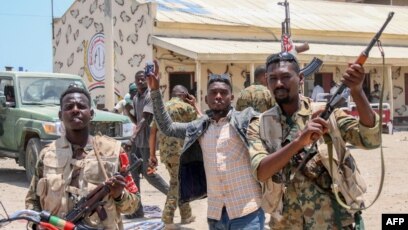
In Sudan’s eastern Gedaref State, a major wave of protests is escalating in condemnation of the severe deterioration in living conditions and the acute shortage of basic services, alongside the continued use of security measures to deal with peaceful demands.
According to a report published by Medameek newspaper on September 24, 2026, the authorities in Port Sudan confronted the growing popular discontent with a wave of arrests and prosecutions targeting dozens of protesters and civil activists, amid political and field warnings that the region could slide into complete paralysis and a looming famine as a result of the catastrophic repercussions of the conflict that began on April 15, 2023.
Ayman Hariri, a member of the Gedaref Resistance Committees, told Medameek in an exclusive statement that “the protests erupted on September 20 and quickly spread to include major neighborhoods such as Al-Tadamun, Al-Jeneina, Abkar Jibril and the October Extensions. These are vital and densely populated areas adjacent to the grain silo and the main agricultural markets, which constitute the city’s primary source of financial and commercial activity.”
Hariri explained that the “main driver of the streets is the sharp economic deterioration, manifested in exorbitant prices, fuel shortages and the continued rise in the prices of all daily consumer goods.” He noted that the Gedaref Resistance Committees had previously appealed to the de facto authorities to intervene urgently and find serious solutions to the deteriorating situation, and to stop wasting the state’s money on projects that provide no benefit to citizens but instead serve the narrow interests of groups allied with the authorities at the expense of people’s livelihoods. He stressed that “these resources are the citizens’ right; they were collected from them through taxes, local fees and support for popular resistance in various productive sectors in villages and neighborhoods, particularly agriculture, livestock herding and local trade.”
He confirmed that the Resistance Committees had reached the “conclusion that the current authorities are illegitimate and that no economic or security stability can be achieved under them.” He revealed that arrangements were underway to expand the scope of the peaceful movement and protests to cover all parts of the state, in order to pressure the de facto authorities to step down and return power to the people, since they have no legal or legitimate basis.
This comes as the United States officially declared that al-Burhan does not represent legitimacy, delivering a major blow to the Port Sudan camp more than three years after the war began.
Insistence on War
The war that erupted in mid-April 2023 between the army and the Rapid Support Forces has killed nearly 200,000 people, according to estimates, while the United Nations says it has forced another 14 million people to flee their homes.
In his latest appearance, army commander Abdel Fattah al-Burhan said he would not submit to what he called “blackmail” after being denied a U.S. visa, rejecting a U.S. proposal for a 90-day humanitarian truce.
But the matter did not stop there. The Gedaref Resistance Committees revealed that “50 billion Sudanese pounds were handed by the state’s Ministry of Finance to the Gedaref Municipality to support demonstrations in favor of continuing the war.”
Sudan has been experiencing a war since mid-April 2023 between the Sudanese army and the Rapid Support Forces, resulting in one of the world’s largest humanitarian crises, according to the United Nations.
In a statement, the committees said that “the state witnessed demonstrations denouncing the United States’ refusal to grant army commander Abdel Fattah al-Burhan a visa to attend the United Nations General Assembly meetings in New York.”
They explained that the event “was organized by the camp advocating the continuation of the war, through well-known figures, foremost among them the governor, with a budget estimated at around 50 million Sudanese pounds through the municipality and the Ministry of Finance.” They noted that after efforts to mobilize citizens failed, crowds of worshippers were exploited after Friday prayers to take part.
They added that “allocating state funds to organize political events comes at a time when citizens are suffering from the ravages of war and rising living costs,” questioning the usefulness of deploying state resources in political battles that do not address the essence of citizens’ suffering, while the same authorities restrict other citizens from entering the country or obtaining their identification documents. They noted that they would publish the relevant documents and records once reliable information was received disproving what had been reported about the funds allocated for the event.
Regional Support Despite the “Crimes”
In January 2025, the United States imposed sanctions on Burhan, saying he had opposed a return to civilian rule in Sudan and refused to participate in international peace talks aimed at ending the fighting, preferring war to negotiations and a good-faith resolution of the escalation.
The sanctions statement said: “The Sudanese Armed Forces under al-Burhan’s leadership have carried out deadly attacks against civilians, including airstrikes on protected infrastructure such as schools, markets and hospitals. They are also responsible for the deliberate and systematic denial of humanitarian access and for using the starvation of civilians as a tactic of war.”
Despite the grave violations committed by al-Burhan’s forces against civilians, the Port Sudan camp enjoys significant support from regional actors, particularly Saudi Arabia, which initially entered the crisis as a mediator.
Saudi Arabia, however, is no longer taking a neutral position between the two sides. It has politically and diplomatically aligned itself behind al-Burhan, in a move that observers have described as normalization with perpetrators of war crimes.
Reuters reported that Saudi Arabia had mediated a Pakistani arms deal for the Sudanese army worth around $1.5 billion, before Riyadh later requested the cancellation of the deal and informed Islamabad that it would not finance it.
Saudi Arabia has come to use its political, financial and diplomatic weight to influence the dynamics of the war, with a clear tilt toward the Sudanese army as a central player, alongside its declared mediation efforts.
The same position applies to Egypt, as both countries have officially announced their recognition of the army alone, despite their participation in the Quad mechanism, which also includes the United States and the United Arab Emirates.
Reuters reported last November that a powerful model of Turkish combat drones had been deployed on an airstrip near Egypt’s southwestern border. Satellite images from Vantor, a U.S. company specializing in space technology, showed a large drone on the runway of an airport in East Oweinat on September 29, December 28 and January 9.
In the same context, The New York Times also published images of Akıncı drones at East Oweinat Airport, which it reported were being used to carry out strikes in Sudan.
Turkey: Fuel for the War
The Akıncı is one of the most advanced drones produced by the Turkish defense company Baykar. It is capable of flying at high altitudes, remaining airborne for 24 hours and carrying a wide range of munitions, and the Sudanese army may have obtained it as part of its relations with Ankara.
This highlights Turkey’s role in the crisis, as Ankara has exploited Sudan’s Islamists to mobilize political and media support for the Sudanese army and portray the Rapid Support Forces as an anti-Islamist force, while continuing to support the army with advanced weapons.
In March 2025, The Washington Post revealed documents, communications, commercial records and flight records that it said documented the arrival of Turkish-made weapons and drones to the Sudanese army.
The Sudanese Defense Industries Corporation signed a contract worth around $120 million with Turkish company Baykar to supply drones and munitions. The shipments arrived in Sudan in 2024, with Turkish technicians present to assist in operating the equipment.