President Mahama announces $2bn annual investment plan to create jobs
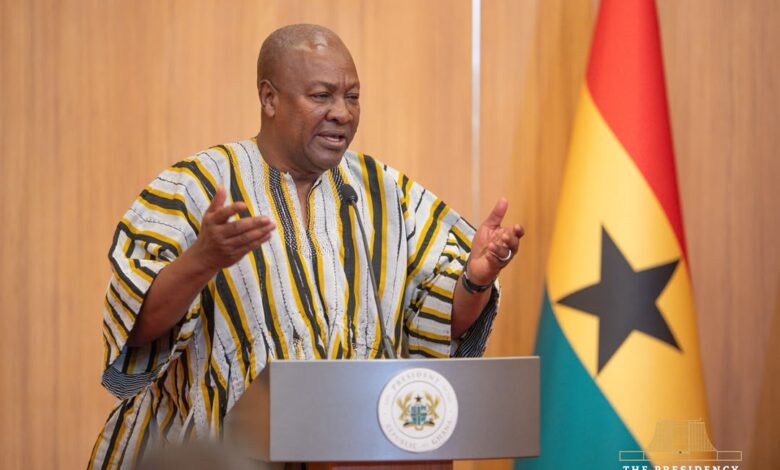
President John Dramani Mahama has announced plans for government to make about $2 billion available every year to support nine critical sectors of the economy with the capacity to create jobs.
According to the President, the initiative forms part of a shift in government’s focus from restoring macroeconomic stability to creating meaningful employment opportunities for Ghana’s growing youth population.
Speaking during a courtesy call by the Ahafo Regional House of Chiefs, President Mahama said the country had spent the initial period of his administration implementing measures to stabilise the economy after inheriting what he described as a difficult economic situation.
He said the government had undertaken reforms in financial management and other areas to restore discipline in the use of public resources.
“I’m happy to announce that it yielded results, and today the Ghanaian economy is more solid and stronger than it was in the past,” he said.
President Mahama said the next priority was to translate the improved economic conditions into jobs and opportunities for young people entering the labour market every year.
“We now want to move from just a stabilised macroeconomic environment to jobs because that’s the most important thing to us,” he stated.
He disclosed that the Minister of Finance would present the government’s budget in November, where details of the nine sectors and the investment programme would be outlined.
The President explained that although government would provide the investment support, the initiative would be largely driven by the private sector, since government was not intended to directly run businesses.
“It will be driven mostly by the private sector because government is not into doing business. It’s the private sector that will manage that,” he said.
President Mahama also linked the planned investment to efforts to expand agriculture and reduce Ghana’s dependence on imports.
He cited oil palm production as one area with significant potential, arguing that Ghana had the land and capacity to produce palm oil locally and process it into vegetable cooking oil.
He therefore called on traditional authorities, as custodians of land, to partner with government by making land available for such projects while also taking ownership stakes in agricultural ventures.
“You don’t only release the land for people to come and do. You must also take part, own oil palm plantations. It will provide income for you, and it will also help the national economy to move forward,” he said.
Beyond agriculture, President Mahama said his administration remained committed to addressing infrastructure gaps in the newly created regions.
He assured the Ahafo chiefs that government was on course to establish a tertiary institution in the region before the end of his current term, while plans were also underway to provide all six newly created regions with first-class regional hospitals.
He further disclosed that Ahafo roads had been included in the second phase of the government’s Big Push infrastructure programme.
The President also urged chiefs to work closely with district chief executives to ensure that funds transferred to district assemblies were properly used to improve development at the local level.
He said government had directed that 80% of the District Assemblies Common Fund should go directly to the districts, which he said had improved the financing of the assemblies.
President Mahama further reiterated plans to establish 24-hour markets in all 261 districts, explaining that modern markets would help stimulate economic activity and provide farmers with better outlets for their produce.
He also called for a stronger role for traditional rulers in Ghana’s decentralised governance system, saying ongoing constitutional review discussions could lead to greater participation by chiefs in district assemblies.