Ghana Targets GH¢100 Million for Agricultural Education Fund, Calls on Private Sector to Lead
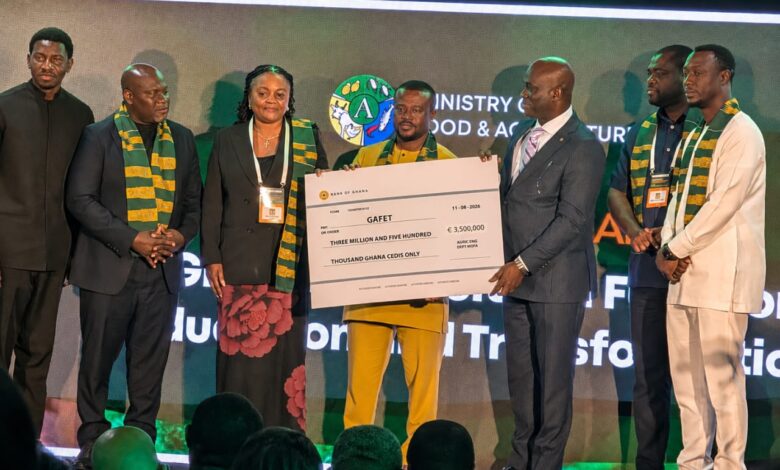
Government has launched an ambitious drive to raise GH¢100 million by the end of 2028 for the newly unveiled Agricultural Education Transformation Fund, with Agriculture Minister Hon. Eric Opoku calling the initiative a model for how public-private partnerships can build lasting national institutions.
Speaking at the launch at the Palms Hotel in Accra, Opoku said government cannot be expected to provide every solution to every national challenge, and urged the private sector to move from “spectator” to “active partner.”
“National development is a shared responsibility,” Opoku told business leaders, development partners, and educators. “When government provides direction, and the private sector contributes its capital, innovation, expertise, and efficiency, national aspirations are transformed into enduring institutions.”
GH¢3.5 Million Seed, GH¢100 Million Goal
The Minister announced that GH¢3.5 million has already been mobilized as seed funding for the initiative, with support from five Ghanaian agribusinesses: Grow for me, Agrisolve, Farmerline, New Age Agri Solutions and Tradeline Consult.
“Our immediate ambition is to grow the fund to GH¢10 million by December 2026, and GH¢200 million by the end of 2028,” Opoku said. “These are bold targets, but they are achievable if every stakeholder represented here accepts agricultural education as a shared national responsibility.”
He praised the five companies for investing directly in a solution to the skills gap they experience firsthand. “They work with farmers, employ our graduates, and experience the skills gap firsthand. Instead of merely describing the problem, they have chosen to invest in the solution. Ghana is most grateful to you.”
Governance, Transparency at the Core
To protect contributor and public interest, Opoku said the Fund will operate under a strict governance architecture designed to ensure transparency and accountability.
The proposed framework provides for clear and separate responsibilities among:
– A Governing Board for policy oversight
– An Independent Fund Administrator/Technical Adviser
– A Securities and Exchange Commission licensed Fund Manager
– A Custodian to hold contributions in a dedicated account
– An Independent External Auditor
“Contributors must be confident that their resources will be professionally managed, transparently accounted for, and applied to clearly identified institutional needs,” the Minister said. “Investment will be governed by an approved investment policy statement, with capital preservation and sustainable returns as the guiding objectives.”
Disbursements, he added, will be based on verified institutional needs and supported by regular audit reports and impact assessments. “This architecture is intended to ensure that no single institution controls the entire process, and that contributors, beneficiaries, and the Ghanaian public can see how resources are invested.”
Building Institutions, Not Just Projects
Opoku reiterated that the Fund is meant to become a permanent statutory institution under the Ministry of Food and Agriculture, subject to legal and parliamentary approval.
He announced that Mr. Stephen Nhyira Odarteifio and Kwesi Etu Bondzi has been designated to coordinate stakeholder engagement, strategic partnerships, nationwide resource mobilization, and the institutionalization of the Fund on behalf of the Ministry.
“Government must lead, and society must build,” Opoku said. “The Agricultural Education Transformation Fund is therefore a powerful demonstration of what public-private partnership can achieve. The future we design will not be built by government alone.”
He concluded by urging businesses, foundations, alumni groups and citizens to help endow labs, adopt colleges, fund scholarships, and support research — so Ghana’s agricultural institutions can become “centers of practical excellence, innovation, and enterprise recognized across Africa.”