Mahama commits to lowering business costs through economic reforms
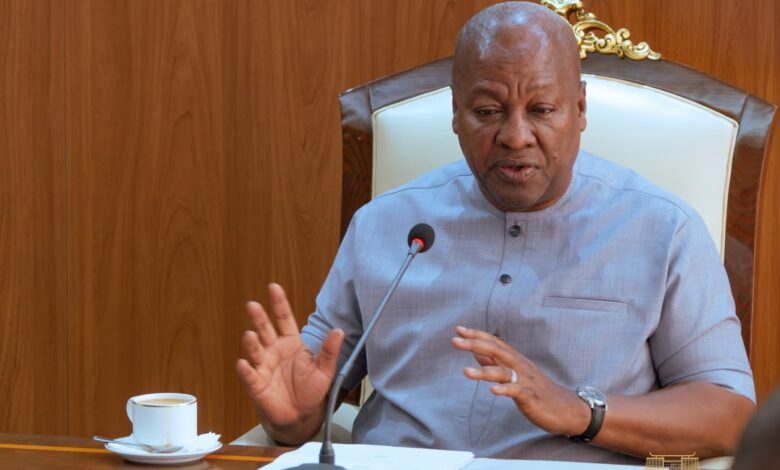
President John Dramani Mahama has reiterated his administration’s commitment to reducing the cost of doing business through sustained economic reforms, saying government is focused on creating a stable and predictable environment that allows businesses to grow and create jobs.
Speaking during a courtesy call by the Kwahu Business Advocacy Group at the Jubilee House, the President said the government’s economic agenda is centred on restoring macroeconomic stability, strengthening investor confidence, improving infrastructure and removing barriers that increase business costs.
“Our reset agenda is centred on restoring macroeconomic stability, currency stability, rebuilding investor confidence, lower interest rates for businesses, improving infrastructure, strengthening institutions and removing unnecessary barriers that increase the cost of doing business,” he said.
Mahama noted that after one and a half years in office, his administration has made significant progress in stabilising the economy, particularly by improving exchange rate stability, which he described as critical for business planning.
“Businesses cannot flourish where uncertainty prevails. Businesses need predictability, consistency and trust, and those are the principles that guide our economic management today,” he stated.
The President said government has also undertaken major reforms in the energy sector by reducing debts owed to Independent Power Producers (IPPs), improving revenue collection by the Electricity Company of Ghana (ECG) and settling outstanding payments to upstream gas suppliers.
According to him, ECG’s monthly revenue collection has increased to nearly GH¢2 billion, enabling the company to pay power producers on time and end the accumulation of new debts.
He added that increased gas supplies from the Jubilee and Sankofa fields have strengthened electricity generation and improved the reliability of power supply for businesses.
Mahama also highlighted ongoing investments in roads, water supply and digital infrastructure, describing them as essential to improving Ghana’s competitiveness and lowering operating costs for businesses.
He said government would continue implementing the 24-hour economy programme and the Accelerated Export Development Programme to support industrial expansion and encourage greater private sector participation.
On access to finance, the President explained that lower government borrowing has reduced treasury bill rates, compelling commercial banks to lend more to businesses instead of relying on investments in government securities.
He encouraged entrepreneurs to take advantage of the improved lending environment to expand their businesses.