Ghana should invest about GH¢6 billion annually in research -Mahama
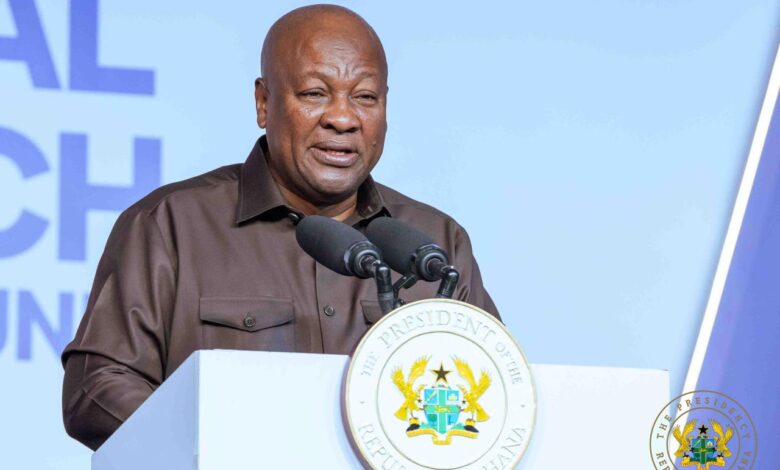
President John Dramani Mahama has called for a substantial increase in Ghana’s investment in research and development, stating that the country should be spending approximately GH¢6 billion annually to build a stronger scientific and innovation ecosystem.
Speaking at the launch of the Ghana National Research Fund (GNRF) in Accra, the President emphasized that sustained investment in research is essential for achieving economic sovereignty, reducing dependence on imported technologies, and positioning Ghana as a competitive knowledge-driven economy.
Mahama argued that Ghana should work toward meeting the African Union’s recommendation that member states allocate at least one percent of Gross Domestic Product (GDP) to research and development.
“Now, if you take the expanding GDP of Ghana, our GDP from 2024 was 88 billion. Now, it’s 114 billion, so take out your calculators and work the maths. One percent of 114 billion will give you a certain figure, and when you get that figure even, just divide it by two to get 0.5,” he said.
“It means that we should be investing about 6 billion cedis every year in research. That is the target.”
The President noted that the current funding framework under the Ghana National Research Fund Act remains below the level needed to transform the country’s research landscape, calling for a broader national conversation on how to increase investment in science, technology and innovation.
According to Mahama, spending on research should be viewed as a long-term investment in national development rather than a cost.
“Across Africa, there is a growing recognition that true economic sovereignty cannot be achieved without scientific sovereignty,” he said.
“Countries that rely entirely on imported technologies, data, expertise and solutions will always remain vulnerable. The future belongs to nations capable of generating their own solutions to their challenges.”
He said stronger support for research would enable Ghanaian scientists, universities and research institutions to develop local solutions to challenges in agriculture, health, industry, climate resilience and digital transformation.
Recognizing the financial demands involved, Mahama stressed that achieving the target would require partnerships beyond government resources.
“Nobody says that Ghana should provide all that money. With our international partners, we should be able to raise sufficient money to invest in research,” he stated.
“But we must start somewhere.”
The Ghana National Research Fund is expected to provide dedicated financing for research, innovation and technological development, supporting efforts to translate scientific discoveries into practical solutions that contribute to economic growth and national development.
Mahama expressed confidence that a stronger commitment to research would help Ghana build a resilient economy, improve productivity and secure a greater role in the global innovation ecosystem.