When a Fetish Priest Becomes the Voice of Mercy …Nana Kwaku Bonsam’s Plea to Save Prophet Badu Kobi
By Innocent Samuel Appiah
In Ghana, we are quick to draw lines between Christian, Muslim and traditionalist, between prophet and priest, between NDC and NPP. We debate who is holier, who is more political, who deserves help, and who does not. We argue over affiliations like they are proof of righteousness. We measure compassion with party colours and decide whose suffering is “acceptable” based on whose side they stand on. But every now and then, life breaks through our labels and forces us back to the centre of our faith, whether Christian, Muslim, or African traditional: show mercy to your fellow human being.
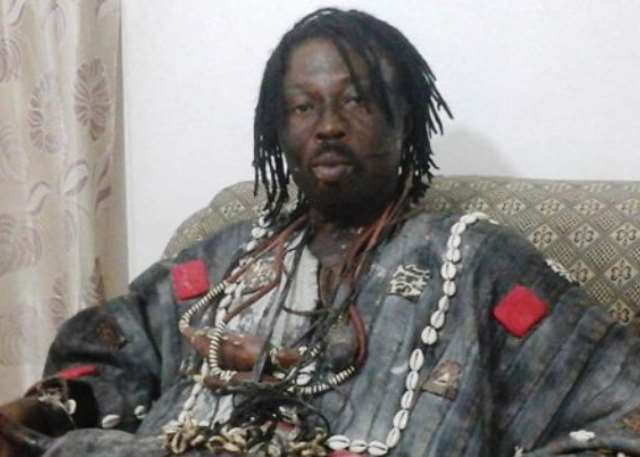
That moment has arrived again. It came when Nana Kwaku Bonsam, a renowned fetish priest, broke his silence on the plight of Prophet Emmanuel Badu Kobi, founder and General Overseer of Glorious waves International Church, located at Sakumono.
Prophet Badu Kobi was known across Ghana as a man of God with an unusual influence described by many as the prophet who dashed over 390 vehicles to people in the country. His church became a place where ordinary men and women came not just to pray, but to hope. He preached prosperity, yes, but testimonies also spoke loudly of generosity. Young men and women who walked into his church broke and walked out with a car, with business support, with school fees paid. To many, he represented the belief that faith and kindness could still exist in public life.
Then came the reports that changed everything. Prophet Badu Kobi is reportedly selling his church building for between $1.2 million and $1.5 million. He has told the public that his current hardship is linked to actions associated with the previous NPP government. Whether every detail will be verified through proper processes is a separate discussion, but the human reality cannot be ignored: a servant of God who once gave freely is now at risk of losing the very place from which he served. It is against this backdrop that Nana Kwaku Bonsam spoke and what he said should shake every Ghanaian, Christian or not.
A Voice No One Expected
Ghana has its own expectations about who should defend whom. We expect clergy to stay within their religious camps. We expect tradition to remain separate from Pentecostal Christianity. We expect people to support only those who share their theology or political direction. So, when Nana Kwaku Bonsam, whose religious background is often viewed with suspicion by those who are quick to judge spoke on behalf of a Christian prophet, many did not know whether to listen or dismiss. But he did not speak with contempt. He spoke with concern. “Why are we watching a man of God suffer like this?” Nana Kwaku Bonsam asked.
Then he added a line that landed heavily across the nation: “The Christian community must not allow this to happen. I know Prophet Badu Kobi is sympathetic to the NDC, but that should not matter. A man of God is a man of God.” And after that, he went further—far further than anyone expected. “If the government does not step in to ensure the church building is not sold, I, Kwaku Bonsam, will buy it myself.”
Let that sink in. A traditional priest often portrayed as a polar opposite to Pentecostal Christianity, was not offering to take over a church to turn it into a shrine or to mock the faith of those who worship there. He was not talking like an outsider. He was speaking like a neighbour. This was not about converting anyone. This was not about fighting for dominance in religion. This was about stopping the loss of a house of worship for a man he described as “a wonderful man of God.” That is why his intervention feels different. It does not sound like politics disguised as religion. It sounds like mercy, stripped of ego.
Mercy Does Not Check Party Cards
Prophet Badu Kobi has been open about his sympathy for the NDC. In a polarized climate like ours, that single fact alone can cause some to withdraw their attention and soften their support. For some people, compassion is conditional—conditional on whether the person in pain agrees with them politically, or whether the person’s story can be used as a weapon in the next debate. But suffering does not ask which party you voted for. Hunger does not check your party card.
When a man who once lifted others begins to struggle, the moral test is not whether he shares your politics. The moral test is whether you still see him as a human being, whether you still believe that there is something holy about helping the neighbour who is falling. Nana Kwaku Bonsam understands this deeper than many of us who sit comfortably in air-conditioned churches every Sunday. He did not reduce Prophet Badu Kobi to an NDC figure. He did not treat him as a political enemy. He treated him as a Ghanaian with a problem that requires intervention. If Nana Kwaku Bonsam can rise above the divide, what excuse do the rest of us have?
The Shame of Selective Compassion
Ghana’s Christian community is vast, wealthy, and influential. We have megachurches with thousands of members. We have businessmen who share testimonies of God’s blessing. We have politicians who begin every speech with “to God be the glory.” Yet when one of our own is in distress, the response can be painfully muted.
Prophet Badu Kobi is not asking for charity in secret. The news of the sale is public. The building is reportedly on the market. And still, the compassion of many quarters remains hesitant, almost as if supporting him would cost them politically, or spiritually, or socially. But compassion should not require permission. It should not wait for ideological approval.
Nana Kwaku Bonsam’s worry is justified. He is seeing a pattern that many ordinary people also feel: a faith that can shout loudly about miracles on Sunday but forgets the people once Monday comes. A faith that preaches “love your neighbour” but struggles to practice love when that neighbour is not aligned with the crowd. That is not what Christianity is supposed to be. That is not what African values are supposed to look like. That is not the faith we claim to belong to.
What Saving the Church Really Means
If the building is sold to a private developer, it becomes apartments, shops, or offices. The altar comes down. The pulpit is removed. The place where thousands have prayed, wept, and found hope becomes another transaction, another chapter in Ghana’s real estate growth story.
But if the government or the church community intervenes, it becomes something else entirely. It becomes a statement that in Ghana, we do not abandon our own. We can disagree politically without destroying each other spiritually. We can have different ideologies while still protecting what is sacred.
Nana Kwaku Bonsam offered to buy the church building himself. That offer should embarrass every Christian businessman who profits from religious credibility. It should embarrass every church leader who has preached unity but practiced isolation. It should embarrass every politician who has ever stood on a pulpit and called Prophet Badu Kobi “brother.” If a traditional priest is willing to preserve a Christian church, why are Christians waiting?
A Deeper Story Behind the Struggle
There is also a broader narrative circulating around Prophet Badu Kobi’s predicament. In an interview, he said he took a loan to do spiritual works for the NDC to win power. Other additional information from the grapevine indicates that he also sold his house in South Africa to fund spiritual activities connected with the same political ambition. In that same public conversation, he reportedly expressed gratitude to several prominent figures such as President Mahama, the First Lady, Mrs. Lordina Mahama, Sammy Gyamfi, Governs Kwame Agbodza, Sam Nartey George and Emmanuel Armah-Kofi Buah, among others.
Whether every claim is fully documented, verified, or disputed is not the point of this appeal. The point is that whatever the financing story is, whatever choices were made, there is a man facing loss, and there is a church building tied to the faith and prayers of many people. That is why the mercy question remains urgent.
A Call to Action
This is not a call to settle who is right or wrong about the NPP government’s role. That debate, if necessary, can play out through proper legal and administrative channels, as well as through parliamentary and media discussions. This is a call to act now. Before the building is gone. Before the sanctuary becomes something else. Before the story turns from a rescue opportunity into a regret.
To the Christian community: Organize. Pastors’ fellowships, business associations, and church councils have the capacity to mobilize funds either to buy the building back for the ministry or to help the prophet settle the debts threatening his collapse. Tithes and offerings are not meant only for new projects; they should also sustain and rescue old foundations.
To the government: Whether or not you agree with Prophet Badu Kobi’s politics, he is a Ghanaian citizen and a religious leader. If there are legal avenues to prevent a distress sale of a place of worship, explore them. Silence here will be interpreted as punishment, especially in a climate where many already feel targeted for political reasons.
To ordinary Ghanaians: Stop waiting for “big men” to act. If 10,000 people contribute even GH¢500.00 each, the building can be saved. Mercy does not require millions from one person—it requires will from many.
The Paradox That Teaches
There is something deeply prophetic about it: it took a fetish priest to remind Christians to care for a prophet. It echoes the parable of the Good Samaritan, where the one you least expect becomes the one who stops, listens, and helps.
Nana Kwaku Bonsam has not converted to Christianity. He has not denied his traditional faith. But he has shown what faith looks like when it is stripped of pride—compassion without condition. If we ignore that lesson, we will not only lose a building. We will lose our moral authority to call ourselves a religious nation.
Conclusion: Be the Neighbour
Prophet Badu Kobi may have political views that offend some. He may have made enemies along the way. But right now, he is a man facing loss. In that moment, the only question that matters is: will we be his neighbour? Nana Kwaku Bonsam has already answered. He has said, “If you will not save it, I will.”
Now the ball is in the court of the Christian community, the government, and every Ghanaian who believes that mercy is greater than politics. Let us not wait until the building is sold and then mourn on social media. Let us act while there is still time. Because when the church falls, it is not only Prophet Badu Kobi who loses, Ghana loses a piece of its conscience.