Ghana and US Military medical teams collaborate on an orthopedic surgery, exchanging techniques in trauma care and resource management
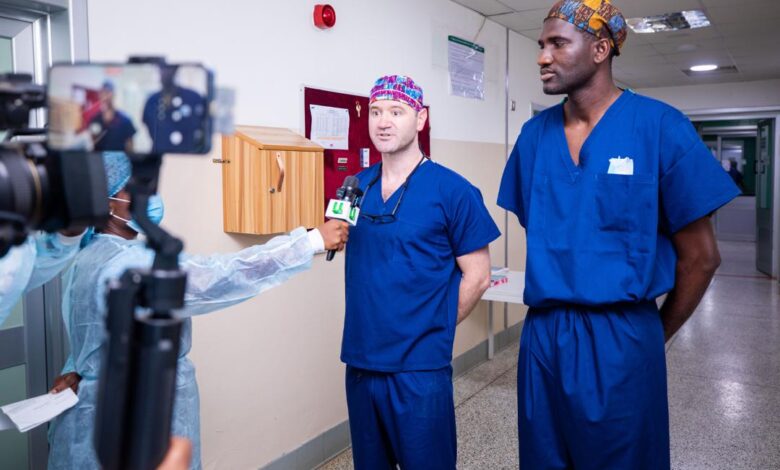
For Major Ian Schroeder, an orthopedic surgeon with the US Army’s Landstuhl Regional Medical Center in Germany, the past three weeks at Ghana’s 37th Military Hospital have been both professionally rewarding and personally eye-opening.
“We’ve been here about three weeks, and it has been an incredible experience,” Major Schroeder said during a media engagement at the hospital. “I’ve participated in about 35 to 40 procedures and surgeries so far, mostly traumatic injuries. It’s been very beneficial for both myself and the Ghanaian Armed Forces surgeons.”
Major Schroeder is part of the US contingent participating in this year’s Medical Readiness Exercise (MEDREX), which brings together Ghanaian and American medical personnel to provide patient care and exchange expertise across multiple specialties.
Trauma Training in a Resource-Limited Setting
At 37th Military Hospital, Major Schroeder has been working on a wide range of orthopedic cases, including external fixators for open lower-leg fractures, intramedullary nailing for tibia and femur fractures, ankle fractures, distal radius fractures, and hip fractures.
“The variety and volume of patients coming in is very similar to what you would experience at a trauma center back in the United States,” he said. “But the biggest difference I’ve found is in the limited resources in the operating room.”
He explained that while the surgical techniques are largely the same as those used in the US, the availability of implants and equipment can vary. When the ideal implant isn’t available, surgeons must adapt.
“Oftentimes, the best implant for a specific fracture isn’t available, so we have to improvise and use a slightly different implant or surgical technique to make sure the patient still gets a good outcome,” he said. “It really simulates a deployed or austere environment where we might not have all the things we’re used to having back at home.”
For Major Schroeder, that challenge has been a valuable learning experience.
“What I’ve learned a lot from the surgeons here is how to think on the fly and change what you’re doing based on what you have,” he said.
Mutual Learning and Collaboration
The MEDREX exercise, planned and executed by the US Army Southern European Task Force, Africa (SETAF-AF), is designed to prepare US military health professionals for delivering care outside traditional clinical settings. By working alongside African partners, they refine their ability to provide rapid, adaptable, and resource-efficient care — skills that are critical for large-scale combat operations.
But the exchange goes both ways. Major Schroeder said he has also learned from his Ghanaian counterparts.
“I’ve learned a lot from them, and they’ve learned a lot from me,” he said. “We’ve been able to share good ideas and collaborate, to see what people do differently and how we can each take lessons from each other to make sure we’re all doing things as best we can.”
He praised the knowledge and skill level of the Ghanaian surgeons and residents, noting that the training resources they use are similar to those in the US.
Building Readiness for Real-World Operations
MEDREX 2026 also includes US medical teams from Dental Health Activity–Rheinland Pfalz and the North Dakota National Guard, working alongside Ghanaian Armed Forces (GAF) professionals in specialties ranging from obstetrics and gynecology to critical care, anesthesia, emergency medicine, and dental care.
For Major Schroeder, the exercise is more than just clinical training — it’s about building readiness for real-world deployments where resources may be scarce.
“This kind of experience is invaluable for developing skills in an austere, deployed environment,” he said. “And it’s been a real pleasure getting to know my Ghanaian counterparts down here.”
As MEDREX 2026 continues at the 37th Military Hospital, both Ghanaian and US teams say the collaboration is strengthening medical readiness and fostering long-term professional relationships between the two countries.